How Much Does It Cost to Keep a Dog per Month in Hong Kong? The Complete 2026 Guide to Dog Expenses: Budgeting for Dog Food and Pet Supplies at a Glance

Quick answer: Keeping a small-to-medium dog (about 10 kg) in Hong Kong in 2026 costs roughly HK$950 to HK$4,750 per month in total, with a median of around HK$2,300 per month. The single biggest expense is always dog food (30–40% of the total), followed by medical care and insurance. The first year also requires one-off spending of HK$5,000–HK$13,000 (vaccinations, desexing, dog licence and basic supplies). The six keys to keeping your budget under control are: Dry and wet dog food: HK$300–HK$1,700 per month — the widest gap of all, depending on the grade of food Treats, supplements and dental products: HK$80–HK$500 per month Medical care, vaccinations, dog licence and insurance: HK$150–HK$900 per month (amortised) Grooming, bathing and cleaning care: HK$150–HK$700 per month Everyday consumables (pee pads, cleaning, deodorising): HK$120–HK$250 per month Equipment depreciation, outings and boarding services: HK$100–HK$700 per month (amortised) The most practical approach for a first-time owner is to choose the “Standard” budget (about HK$2,300 per month): use a mid-to-high-grade natural food, do one annual health check, buy a basic pet insurance plan, and stock up on the rest of your supplies in one go at the BC Pets Super Value Deals section — free delivery on orders…

Continue ReadingHow Much Does It Cost to Keep a Dog per Month in Hong Kong? The Complete 2026 Guide to Dog Expenses: Budgeting for Dog Food and Pet Supplies at a Glance

Your pet food bowl may be endangering your pet’s health | Pet food bowl selection and health report

Newsweek's latest report warns that if pet food bowls are not cleaned enough, they can become breeding grounds for bacteria, increasing the risk of gastrointestinal discomfort and cross-contamination between humans and pets; In Hong Kong's hot and humid environment, it is recommended to prioritize easy-to-clean, non-porous, and durable food bowls, such as stainless steel or high-quality ceramics, and develop the habit of washing after every meal and cleaning the drinking bowl daily. BC Pets offers a wide range of pet food utensils to choose from, including stainless steel bowls, slow food bowls, diagonal bowls, and water dispensers. Key Summary TL; DR: Food bowls themselves can also harbor bacteria: Research and veterinary reports indicate that pet bowls can accumulate bacteria, mold, and biofilms. Material matters: stainless steel is usually easier to clean and holds less dirt; Plastic and cracked ceramics are more likely to become hiding places for bacteria. Wet grains carry higher risks: When using wet grain, residues on the bowl surface are more likely to breed microorganisms, so cleaning frequency is higher. Cleaning habits determine risk: It is recommended to wash the food bowls after each meal, and the drinking bowls at least once a day. Hong Kong should…

Continue ReadingYour pet food bowl may be endangering your pet’s health | Pet food bowl selection and health report

Common Dog Food Ingredient List Explained 2026 | Hong Kong dog food, natural dog food, and dog food all good—a complete guide to everything

To judge whether dog food is good, look at five things: 1) Is the primary ingredient named animal protein; 2) Whether crude protein and crude fat match the dog's age and activity level; 3) Whether there are complete AAFCO or FEDIAF nutritional standards; 4) Whether it contains clearly labeled fats, fiber, vitamins, and minerals; 5) Whether it comes from reliable sources. Generally speaking, high-quality natural dog food centers on clear animal protein, suitable fats, digestible carbohydrates, essential fatty acids, and complete micronutrients. Key Summary TL; DR: Let's look at the first ingredient: High-quality dog food usually prioritizes well-known animal proteins such as chicken, salmon, and lamb. Adequate protein: Adult dogs generally consume about 20–25%, while puppies typically require higher protein to support growth. Fat is an energy source: Fat provides energy, helps absorb fat-soluble vitamins, and also affects the condition of hair and skin. Fewer carbohydrates are not always better: it depends on the source and digestibility. Sweet potatoes, brown rice, oats, and other foods are commonly found in natural formulas. Complete nutrition is most important: staple dog food should have AAFCO or FEDIAF complete and balanced claims. In Hong Kong, pay attention to storage: high temperature and humidity accelerate…

Continue ReadingCommon Dog Food Ingredient List Explained 2026 | Hong Kong dog food, natural dog food, and dog food all good—a complete guide to everything

Small Dog Food Recommendations 2026 | Complete Guide to Choosing Small Dog Food in Hong Kong + Comparison of 6 Popular Dog Foods

Quick answer: Small breeds (adult dogs weighing about 10 kg or less, such as Lady, Chihuahua, Joseph's Daddy, Squirrel Dog, French Bulldog, etc.) have high metabolic rates, are prone to hypoglycemia, and have small mouths. Therefore, it is recommended to choose small breed dog food with high calorie density, sufficient animal protein, small particles, and formulas certified by AAFCO for "Complete Balance." When purchasing, keep in mind five key points: (1) Calorie density and protein, (2) Pellet size and chewing, (3) Age group, (4) Weight and dental management, (5) Official product source and palatability。 BC Pets sells a variety of dog foods exclusively for small dogs, including Orijen Desire Small Adult Breeds, Fromm Gold Small Breeds (Small Pellets), Wellness CORE Grain-Free Small Adult Breeds, Solid Gold Mighty Mini, Stella & Chewy's Free-Range Small Dogs, and more. All are authentic Hong Kong products, and orders over HK$350 get free shipping across Hong Kong. Key Summary TL; DR: Sufficient calories: Small dogs require more calories per kilogram of body weight than large dogs, so it is advisable to choose formulas with high calorie density to prevent hypoglycemia. Small granules: Small dogs have small mouths and teeth, so the "fine pellet" design makes…

Continue ReadingSmall Dog Food Recommendations 2026 | Complete Guide to Choosing Small Dog Food in Hong Kong + Comparison of 6 Popular Dog Foods

Senior Cat Nutritional Needs and Food Conversion Guide 2026 | Hong Kong Recommended Old Cat Food and Natural Food Selection Guide

The core of recommending senior cat food is not just about "age," but also whether the protein is sufficient and easy to digest, whether phosphorus is appropriate, whether taurine and water support are available, whether calories are suitable for weight management, and whether the food transition is progressive. If you want to start with the common and easier options in Hong Kong, you can prioritize BC Pets' Natural Cat Food category, including senior formulas, low-allergy single protein formulas, and wet food/main food cans, such as the Wellness CORE series, Fromm, ACANA, Canagan, Farmina N&D, Kakato main food cans, etc. Key Summary TL; DR: Older cats don't just need to eat less: senior cats need digestible protein, sufficient taurine, and a steady calorie diet. Phosphorus and kidney management are very important: When choosing food, pay attention to whether the brand clearly displays nutritional analysis and complete nutrition claims. Gradual transition: Generally, it is recommended to switch food in stages every 7–10 days; if sensitive stomachs are affected, the transition can be extended to 14 days. Dry food is not always the best: Hong Kong's weather tends to be hot and humid, so wet food or mixed dry and wet feeding is…

Continue ReadingSenior Cat Nutritional Needs and Food Conversion Guide 2026 | Hong Kong Recommended Old Cat Food and Natural Food Selection Guide

How to deal with constipation in cats? Causes, symptoms, and ways to improve diet and lifestyle

  • Post last modified:2026-07-15
  • Post category:Pet Encyclopedia

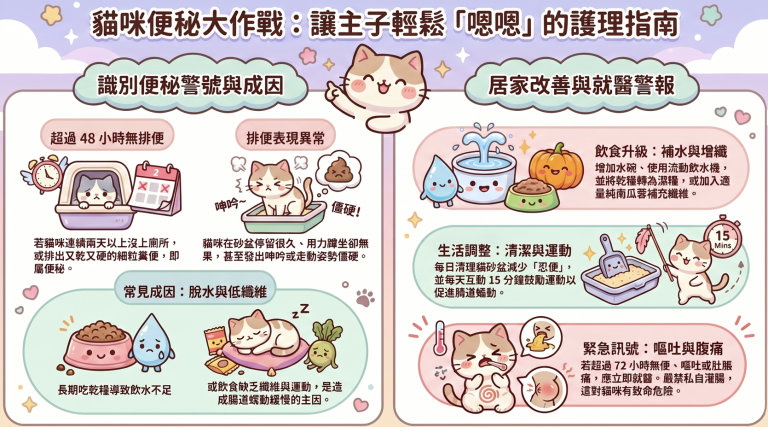
This article is suitable for cat owners whose cats have irregular bowel movements, dry and hard bowel movements, or who want to prevent constipation. Key Highlights (TL; DR) Definition: If a cat has not defecated for more than 48 hours or has passed dry, hard, fine feces, it is considered constipation. Common causes: insufficient water intake, insufficient fiber, obesity with little exercise, stress, as well as kidney disease, diabetes, hyperthyroidism, and other conditions. Dietary improvement: Increase water intake, switch to or add wet foods, and appropriately supplement with fiber (such as pure pumpkin puree). Lifestyle improvement: Keep the litter box clean, encourage exercise, control weight, and reduce stress. Warning signs: No bowel movements, vomiting, abdominal bloating and pain, loss of appetite, and severe mental distress for more than 48–72 hours—seek medical attention immediately. What is cat constipation? Feline constipation refers to a cat defecating less frequently, difficulty defecating, or passing dry and hard feces. Healthy cats generally have one bowel movement per day; If you notice your cat hasn't defecated for more than 48 hours, or is straining hard in the litter box but only gets a few small, hard droppings, you can basically treat it as constipation. Mild constipation…

Continue ReadingHow to deal with constipation in cats? Causes, symptoms, and ways to improve diet and lifestyle

Pet Feeding Portion Calculator – 2026 Edition

  • Post last modified:2026-08-29
  • Post category:Pet Encyclopedia

We often hear customers ask how much food is the right amount to feed their pet, or whether their beloved cat or dog is eating too much or too little, so BC Pets designed this Pet Feeding Portion Calculator to help everyone estimate feeding portions for reference. The Pet Feeding Portion Calculator is very easy to use — just follow the 3 steps below to complete it. We hope it helps all pet owners! #DogFoodPortionCalculator #DogFoodPortions #CatFoodPortions Step 1: Please enter your pet's weight Your pet's (cat/dog) weight: kg Step 2: Please select your pet's type Pet type: Growing kitten Adult cat (not neutered) Adult cat (neutered) Adult cat prone to obesity Adult cat on a diet Pregnant queen Nursing queen Puppy 4 months old or under Puppy 4-12 months old Adult dog (not neutered) Adult dog (neutered) Adult dog prone to obesity Adult dog on a diet Bitch within 6 weeks of pregnancy Bitch 7-9 weeks pregnant Nursing bitch Light working dog Moderate working dog Heavy working dog Step 3: Please enter the caloric content of the pet food The caloric content of the pet food (cat food/dog food): kcal/cup (kilocalories/per cup) (default is 400) * The caloric content…

Continue ReadingPet Feeding Portion Calculator – 2026 Edition

Staying up late to watch the World Cup—does the cheering make pets anxious? Guide to Cat and Dog Emotional Coping and Noise Calming

  • Post last modified:2026-07-17
  • Post category:Pet Encyclopedia

Quick answer: The 2026 World Cup will be held from June 11 to July 19. Most matches are broadcast live in Hong Kong from early morning until early morning. Owners stay up late watching matches and can't help but cheer loudly when scoring goals. Sudden noises and changes in routine can easily make cats and dogs anxious. Common anxiety warning signs include trembling, hiding, restless pacing, panting, excessive barking, or meowing. To soothe your pet, you can approach it in seven ways: (1) Create a safe space for them; (2) Lower volume and draw curtains to minimize sound and light stimulation; (3) Use pheromones (Adaptil for dogs, Feliway for cats); (4) Try to maintain the original feeding and daily routine; (5) The owner himself remains calm; (6) Let it exercise and burn off energy before the race; (7) Distract attention with toys or snacks. If the condition is severe, consult a veterinarian. Key Highlights (TL; DR): Noise anxiety is common: studies show a fairly high proportion of dogs have a fear response to sudden loud noises (such as thunder, fireworks, or cheering). Cheers are the trigger: sudden shouting, table slamming, and celebrations at the moment of scoring can easily scare…

Continue ReadingStaying up late to watch the World Cup—does the cheering make pets anxious? Guide to Cat and Dog Emotional Coping and Noise Calming

Foods Cats Can’t Eat: Toxic and Safe Food Lists

  • Post last modified:2026-07-20
  • Post category:Pet Encyclopedia

Quick answer: Foods cats must never eat include lilies (highly toxic), onions, garlic and chives, chocolate and caffeine, grapes and raisins, alcohol, xylitol, raw fish and raw egg white. Among these, lilies are a deadly poison to cats, and even licking the pollen can cause acute kidney failure. If you suspect your cat has eaten something toxic, contact a vet immediately and make a note of the type of food and the amount. Foods cats must never eat (danger list) Cats are obligate carnivores, and their digestive system is very different from ours. Many everyday human foods are toxic to cats, and even small amounts can be fatal. The list below is ordered by level of danger: FoodDanger levelEffect on catsLilies (all varieties, including the pollen and vase water)FatalAcute kidney failure. One of the most dangerous plants for cats; even licking a small amount of pollen can cause poisoningOnion, spring onion, garlic, chives (harmful raw, cooked or powdered)HighDestroys red blood cells, causing haemolytic anaemia; the effect can build up over timeChocolate, cocoaHighTheobromine and caffeine poisoning, affecting the heart and nervous systemCoffee, tea, energy drinks (caffeine)HighRapid heartbeat, seizures, tremorsGrapes and raisinsHighCan cause acute kidney injury; no safe amount is known, so…

Continue ReadingFoods Cats Can’t Eat: Toxic and Safe Food Lists

Pet Probiotics Guide: Best Probiotics for Cats and Dogs with Soft Stool, Diarrhoea or Switching Food

You often hear people say "a healthy gut means a strong immune system" - and that applies just as much to cats and dogs. As a devoted pet parent, you have almost certainly seen your pet suddenly pass soft or runny stools, vomit for no obvious reason, or get diarrhoea the moment you switch food. Watching them suffer is heartbreaking. There are countless brands of pet probiotics on the market, so which pet probiotic is actually good? When should you start giving them, and what ingredients should you look for? This complete guide breaks down the 3 golden rules for choosing pet probiotics for Hong Kong pet parents, so you can target the real problem and protect your dog's or cat's sensitive tummy. Quick 5-second answer: when should pets start taking probiotics, and how do you choose? Key takeaway: When your pet has long-term soft stool, constipation, bad breath or skin sensitivity, or is in the middle of switching food or a course of antibiotics, probiotics are very much needed. When choosing, look for **"a strain number (such as L. acidophilus LAP5)", "a live bacteria count (CFU) of 2 billion-5 billion" and "encapsulation technology (so the bacteria reach the gut)"**…

Continue ReadingPet Probiotics Guide: Best Probiotics for Cats and Dogs with Soft Stool, Diarrhoea or Switching Food