Quick answer: Keeping a small-to-medium dog (about 10 kg) in Hong Kong in 2026 costs roughly HK$950 to HK$4,750 per month in total, with a median of around HK$2,300 per month. The single biggest expense is always dog food (30–40% of the total), followed by medical care and insurance. The first year also requires one-off spending of HK$5,000–HK$13,000 (vaccinations, desexing, dog licence and basic supplies). The six keys to keeping your budget under control are:
- Dry and wet dog food: HK$300–HK$1,700 per month — the widest gap of all, depending on the grade of food
- Treats, supplements and dental products: HK$80–HK$500 per month
- Medical care, vaccinations, dog licence and insurance: HK$150–HK$900 per month (amortised)
- Grooming, bathing and cleaning care: HK$150–HK$700 per month
- Everyday consumables (pee pads, cleaning, deodorising): HK$120–HK$250 per month
- Equipment depreciation, outings and boarding services: HK$100–HK$700 per month (amortised)
The most practical approach for a first-time owner is to choose the “Standard” budget (about HK$2,300 per month): use a mid-to-high-grade natural food, do one annual health check, buy a basic pet insurance plan, and stock up on the rest of your supplies in one go at the BC Pets Super Value Deals section — free delivery on orders over HK$350.
Key takeaways (TL;DR):
- Three budget levels: Economy at about HK$950 per month, Standard at about HK$2,300, and Premium at about HK$4,750 — the main differences lie in the grade of food and the medical arrangements.
- Dog food is the biggest variable: For the same 10 kg dog, feeding an economy food versus a freeze-dried raw food can differ by as much as HK$9,600 a year in food costs alone.
- The dog licence is a legal requirement: The AFCD charges HK$80 per dog, once every three years; keeping an unlicensed dog older than five months carries a maximum fine of HK$10,000.
- Body size directly determines food costs: A large dog (over 25 kg) eats roughly 2.5–3 times as much food as a small dog, while other expenses differ only modestly.
- Saving money isn’t about buying cheap: it’s about “getting the portion right, choosing the right food, buying genuine local-market products, and stocking up in one order to save on delivery.” Over the long run, saving on medical bills matters far more than saving on food.
- Set aside an emergency fund: we suggest reserving at least HK$15,000–HK$30,000 as a medical emergency fund, or transferring the risk through pet insurance.
Introduction: Before getting a dog, it’s best to work out the numbers first
Before deciding to get a dog, many people only work out the cost of a bag of dog food, without factoring in the dog licence, vaccinations, desexing, grooming, pee pads, supplements and unexpected medical bills. The result is that six months in, they discover their actual monthly spending is double what they imagined — which ultimately affects the quality of care their furry friend receives.
What’s more, keeping a dog in Hong Kong is not simply a matter of “good intentions” — it carries legal responsibilities. Under the Rabies Regulation (Cap. 421A of the Laws of Hong Kong), every dog over five months old must be microchipped, vaccinated against rabies and licensed, or the owner faces a maximum fine of HK$10,000. The fee charged by public officers authorised by the Agriculture, Fisheries and Conservation Department (AFCD) is HK$80 per dog, with the licence and rabies vaccination valid for three years. It isn’t a lot of money, but it is not optional.
BC Pets has been operating in Hong Kong since 2009, with our shop in Fanling and orders also taken online and by phone. Over more than a decade we have seen too many first-time owners misjudge their budgets, so this article won’t simply list a set of tidy figures. Instead, we break monthly spending into six categories, giving realistic 2026 Hong Kong price ranges for each, along with a full comparison of three budget levels — so that before you buy dog food and buy pet supplies, you already have a workable number to go by.
1. Dry and wet food: HK$300–HK$1,700 per month, 30–40% of total spending
Dog food is the one expense that “happens every day and is entirely within your control,” and it is also the category with the widest gap between the three budget levels. For a 10 kg adult dog, daily dry-food intake is around 150–200 g, or roughly 4.5–6 kg a month. The actual portion should be adjusted for activity level, age and desexing status — you can first work it out precisely with our pet feeding portion calculator. Overfeeding both wastes money and leads to your dog becoming overweight.
When choosing a food, we recommend at least confirming that the packaging carries an AAFCO (Association of American Feed Control Officials) nutritional adequacy statement, which shows the formula meets the complete nutritional needs of the corresponding life stage; also refer to the storage and purchasing advice in the AFCD Pet Food Safety Guidelines.
| Food grade | Reference unit price | Monthly food cost for a 10 kg dog | Features | Suitable for |
|---|---|---|---|---|
| Basic dry food | About HK$50–70/kg | HK$270–380 | Meets basic nutritional standards; higher proportion of grains | Tight budget; dog has no particular stomach or skin issues |
| Mid-to-high-grade natural food / grain-free food | About HK$100–130/kg | HK$540–780 | High proportion of animal protein; few additives | Most family dogs; the most common choice |
| Single-protein hypoallergenic food | About HK$120–150/kg | HK$650–900 | Single animal protein; makes it easy to isolate food sensitivities | Itchy skin, soft stools, suspected food sensitivity |
| Freeze-dried raw / air-dried staple food | About HK$200–320/kg | HK$1,080–1,730 | Low-temperature processing; highest palatability | Fussy eaters, owners seeking top quality, small dogs |
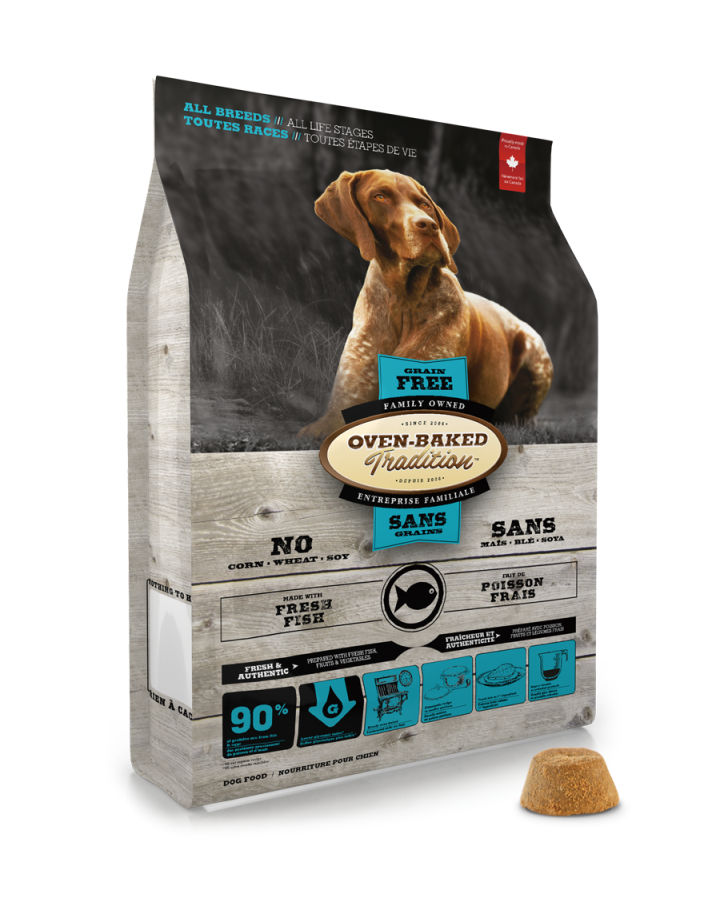
Besides dry food, most owners add staple canned or wet food, or use mixers and toppers to boost palatability and hydration, adding anywhere from HK$50 to HK$600 a month.
Tip: Always switch foods gradually over 7–10 days — new food at 25% on days 1–3, 50% on days 4–6, 75% on days 7–9, and a full switch on day 10. A sudden change of food is one of the common reasons Hong Kong dogs end up at the vet with soft stools; saving on food only to pay a consultation fee simply isn’t worth it.
2. Treats, supplements and dental products: HK$80–HK$500 per month
This is the category where it’s easiest to “overspend without noticing,” because each purchase is only a few dozen dollars — yet by month’s end it often makes up more than 10% of total spending. We suggest handling it in three tiers by “necessity”: training treats are essential, dental products are a high-value preventive investment, and other supplements should be added only according to actual health needs.
| Item | Reference monthly cost | Necessary? | Notes |
|---|---|---|---|
| Training treats | HK$60–150 | Essential | Essential for puppy socialisation and basic obedience training |
| Long-lasting dental chews (e.g. cheese bones, antlers) | HK$80–200 | Recommended | Reduces tartar build-up and eases destructive chewing |
| Dental powder / toothpaste and toothbrush | HK$50–120 | Recommended | A single scale-and-polish requires anaesthesia and can cost several thousand dollars — prevention costs far less |
| Joint supplements (glucosamine) | HK$120–250 | As needed | Recommended for large dogs, those over 7 years old, and breeds prone to patellar luxation |
| Gut probiotics | HK$80–180 | As needed | Dogs prone to soft stools or with sensitive stomachs |
| Skin and coat (fish oil, etc.) | HK$100–200 | As needed | Hong Kong is humid, so skin problems are common |
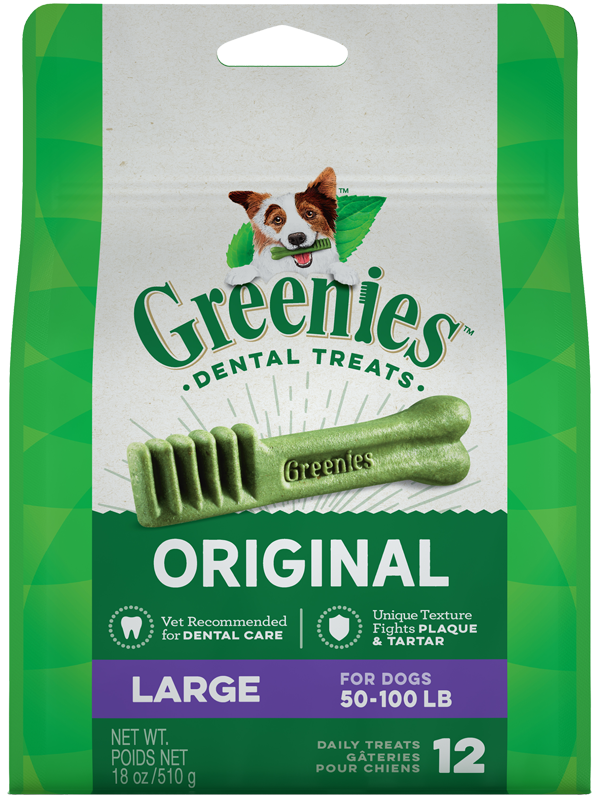
For related products, see dog treats, oral care products, bone and joint supplements and gastrointestinal supplements.
Tip: The total calories from treats (including training treats) should be kept within 10% of daily total calories; exceeding this leads directly to weight gain. Hong Kong indoor dogs generally have low activity levels, so being overweight is the most common preventable health problem — and the joint and metabolic diseases caused by obesity cost far more in medical bills than the treats you saved on.
3. Medical care, vaccinations, dog licence and insurance: HK$150–HK$900 per month (amortised)
Medical care is the one expense you “can’t under-budget for.” A general vet consultation in Hong Kong, including basic medication, costs about HK$400–HK$800, and can reach several thousand dollars for emergencies or when imaging is needed. We suggest spreading fixed annual costs across a monthly budget, and separately setting aside an emergency fund or taking out insurance.
| Item | Frequency | Hong Kong reference cost | Amortised per month |
|---|---|---|---|
| Dog licence + microchip + rabies vaccination (AFCD) | Every 3 years | HK$80 | About HK$2 |
| Annual combination vaccine + basic health check | Yearly | HK$1,200–2,500 | HK$100–210 |
| Deworming (internal and external) | Every 3 months | HK$150–400 / time | HK$50–135 |
| Flea-control spot-on | Monthly (essential in summer) | HK$80–200 / dose | HK$60–150 |
| Pet insurance (basic to mid-tier) | Yearly | HK$2,500–6,000+ | HK$210–500 |
| Reserve for unexpected consultations | Varies | HK$400–800 / time | HK$100–200 |

Dog licence fees and the application procedure follow the official AFCD page: a dog can be vaccinated and licensed from three months old, and this must be completed before five months of age; a replacement dog licence costs HK$82. Note, too, that the vast majority of pet insurance plans on the market do not cover desexing surgery, preventive vaccinations, deworming or nutritional supplements, and pre-existing conditions before taking out the policy are also not covered.
For flea-control and deworming products, see flea / tick / deworming products and flea-control products for outings.
Tip: Hong Kong summers are humid and hot, with long active seasons for fleas and ticks, and dogs are most at risk after walks on the grass. No single flea-control product can prevent infestation completely, so we recommend a combination of “spot-on + outing spray + regular flea comb,” and checking the armpits, behind the ears and between the toes after every trip outdoors.
4. Grooming, bathing and cleaning care: HK$150–HK$700 per month
Grooming costs depend heavily on coat type and whether you do it yourself. Short-haired dogs (such as village dogs and French bulldogs) can simply be bathed at home, while long-haired dogs (such as poodles, schnauzers and Shih Tzus) essentially must be clipped regularly, or their coats will mat to the point of causing skin inflammation.
| Option | Frequency | Cost per session | Amortised per month | Suitable for |
|---|---|---|---|---|
| Bathing at home yourself | Every 3–4 weeks | Shampoo amortised at about HK$40 | HK$40–60 | Short-haired dogs, small size, easy-to-handle dogs |
| Basic bath and blow-dry at a pet shop | Every 3–4 weeks | HK$180–350 | HK$180–350 | Medium dogs; no facilities to blow-dry at home |
| Bath + clip and style | Every 4–8 weeks | HK$400–800 | HK$250–700 | Long-haired dogs, poodles, schnauzers, etc. |
| Full grooming for large dogs | Every 6–8 weeks | HK$700–1,200 | HK$120–200 | Golden retrievers, huskies, etc. (most only need a bath) |
If you handle it at home, the main fixed cost is bathing products, plus ear cleaning and paw cleaning products.
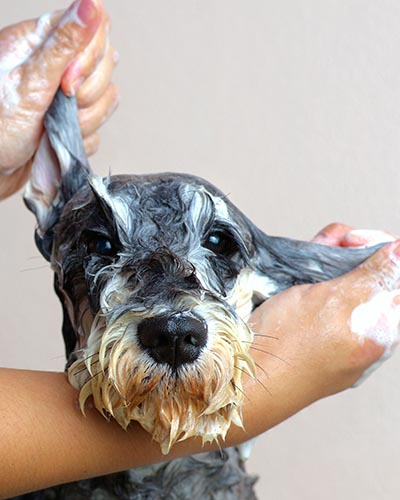
Tip: Bathing too often is a common cause of dry, itchy skin in Hong Kong dogs. For a generally healthy dog, we recommend a bath about once every 3–4 weeks, using a hypoallergenic or moisturising formula; if a vet has diagnosed a skin condition and prescribed a medicated shampoo, follow the prescribed frequency and do not reduce or increase it on your own.
5. Everyday consumables: HK$120–HK$250 per month
The amounts here aren’t large but are completely unavoidable, and usage is fairly steady — making this the part where it’s easiest to save by “buying in bulk in one go.”
| Consumable | Reference monthly usage | Monthly cost | Money-saving approach |
|---|---|---|---|
| Pee pads / diapers | 60–100 pieces | HK$100–180 | Buy large packs, and use a dog potty tray to reduce waste |
| Poop bags | About 60–90 bags | HK$20–40 | Buy by the box — the unit price can be as low as half |
| Household deodoriser / cleaner | About 1 bottle | HK$30–60 | Choose a pet-specific, fragrance-free formula |
| Wet wipes / paw cleaning | 1–2 packs | HK$25–50 | Buy together with bathing products to reach the free-delivery threshold |
For related products, see pee pads / diapers, dog potty trays / toilets and household cleaning / pest-control / deodorising products.
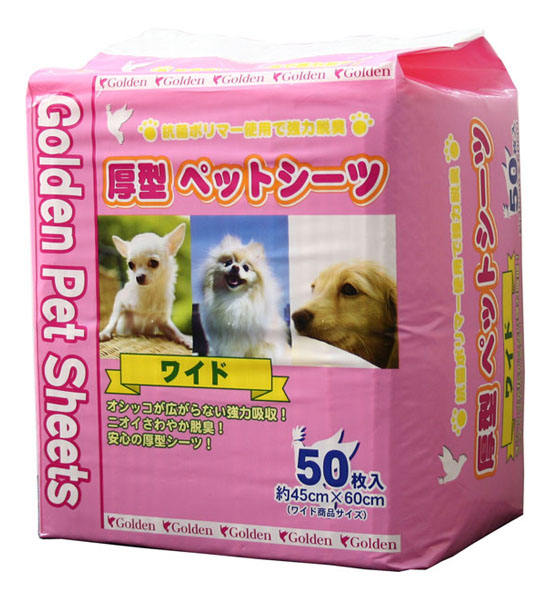
Tip: Using a dog potty tray with pee pads solves two costly problems at once: it stops the dog from tearing the pads apart (several wasted a day), and it prevents them from stepping in their own urine and tracking it around, reducing cleaner usage. Saving 20 pads a month, it pays for itself in around six months.
6. Equipment depreciation, outings and boarding services: HK$100–HK$700 per month (amortised)
Leashes, dog beds, toys and carriers are durable goods, and the correct approach is to spread the purchase price over their expected lifespan. The real variable is boarding and dog-sitting — a single trip away can double that month’s spending.
| Item | Purchase price / fee | Lifespan | Amortised per month |
|---|---|---|---|
| Harness + leash | HK$250–600 | About 2 years | HK$10–25 |
| Dog bed / mat | HK$300–900 | About 2 years | HK$13–38 |
| Food bowl, food storage container | HK$200–500 | About 3 years | HK$6–14 |
| Toys (will get chewed up) | HK$60–200 / item | About 1–3 months | HK$40–120 |
| Carrier / pet stroller | HK$500–2,000 | About 3 years | HK$14–56 |
| Boarding / dog-sitter | HK$180–500 / day | As needed | HK$0–500 |
For guidance on what to buy, see dog harnesses / collars / leashes, pet beds / mats, dog toys and pet bags / backpacks.
Tip: A more expensive leash isn’t necessarily better — it needs to suit how your dog behaves on walks. A well-behaved dog that doesn’t pull is most comfortable in an H-shaped or figure-of-eight harness; a dog that’s easily distracted and needs a prompt can use a half-check collar; and for a dog that lunges, we recommend a front-clip harness, which reduces the pulling force by changing the direction of force while protecting the neck and windpipe. Choosing the right one often saves more money than buying three to try.
A full comparison of the three dog-keeping budget levels (based on a 10 kg small-to-medium dog)
| Item | Economy | Standard | Premium |
|---|---|---|---|
| Staple food | HK$300 | HK$650 | HK$1,100 |
| Wet food / toppers | HK$50 | HK$250 | HK$600 |
| Treats and supplements | HK$80 | HK$250 | HK$500 |
| Medical care, vaccinations, dog licence, insurance | HK$150 | HK$450 | HK$900 |
| Grooming and cleaning care | HK$150 | HK$250 | HK$700 |
| Everyday consumables | HK$120 | HK$180 | HK$250 |
| Equipment depreciation and outing services | HK$100 | HK$250 | HK$700 |
| Monthly total | About HK$950 | About HK$2,280 | About HK$4,750 |
| Yearly total | About HK$11,400 | About HK$27,400 | About HK$57,000 |
| Food grade | Basic dry food | Mid-to-high-grade natural food + wet food | Freeze-dried raw / air-dried staple food |
| Medical arrangements | Annual vaccinations, no insurance | Annual vaccinations + health check + basic insurance | Half-yearly health check + mid-to-high-tier insurance |
| Grooming arrangements | Mostly done at home yourself | Monthly bath at a shop | Monthly professional clip and style |
| Best suited for | Limited budget; dog has no particular health issues | Most Hong Kong families and first-time dog owners | Those seeking top quality who travel often and need boarding |
Our brand recommendation: of the three, we suggest first-timers start straight from “Standard”
Based on more than a decade of actual sales and customer follow-up in Hong Kong, we don’t recommend that first-timers start with the Economy level, nor that they leap straight to Premium. The reasons are as follows:
The problem with Economy isn’t food quality — it’s that there’s “too little flexibility.” A budget of HK$950 a month leaves almost no slack, so a single bout of gastroenteritis requiring a consultation (HK$600–1,200), or an urgent switch to a hypoallergenic food, throws the whole month’s plan into disarray — which often ends up as delaying a vet visit. If you do choose Economy, we strongly recommend setting aside at least an extra HK$300 a month as a medical emergency fund.
The problem with Premium is diminishing returns. Freeze-dried raw food is indeed excellent, but for a healthy adult dog with no history of sensitivities, upgrading from a mid-to-high-grade natural food to freeze-dried raw costs about HK$9,000 more a year, with a health improvement far smaller than “putting that money towards an annual health check + insurance + weight control.” Unless your dog is a severely fussy eater or has specific needs, there’s no need to max out from the start.
Standard (about HK$2,300 a month) offers the best return. It does all three of the most important things at once: feeding a quality natural food that meets AAFCO standards, doing an annual health check, and having insurance that can cover major surgery. These three are what truly affect your dog’s lifelong health and your long-term spending. Supplies and consumables, meanwhile, can be kept low in the Super Value Deals section, and the money saved neatly tops up the medical budget.
How monthly spending differs by body size
| Body size | Weight range | Monthly food cost (Standard) | Total monthly spending (Standard) | Common breeds |
|---|---|---|---|---|
| Small dogs | Under 10 kg | HK$350–650 | About HK$1,600–2,300 | Chihuahua, poodle, Shih Tzu |
| Medium dogs | 10–25 kg | HK$650–1,300 | About HK$2,300–3,300 | Village dog, French bulldog, Shiba Inu |
| Large dogs | Over 25 kg | HK$1,300–2,200 | About HK$3,300–4,800 | Golden retriever, Labrador, husky |
Tip: Body size mainly affects food costs and medication dosage, with relatively little impact on grooming, consumables and insurance. So the claim that “a large dog costs several times more” isn’t accurate — the actual total monthly spending is only about 50–80% higher, though one-off medical procedures (such as surgical anaesthesia) and boarding fees are noticeably higher.
One-off expenses in a dog’s first year
| One-off item | Reference cost | Notes |
|---|---|---|
| Dog licence + microchip + rabies vaccination | HK$80 (AFCD) | Legally required; private vet clinic fees are charged separately |
| Puppy combination vaccines (3 shots) | HK$1,200–2,400 | From about 6–8 weeks of age, one shot every 3–4 weeks |
| First internal and external deworming | HK$150–400 | Every 3 months thereafter |
| Desexing surgery | HK$2,000–6,000 | Depends on sex, weight and clinic; generally not covered by insurance |
| Basic supplies set | HK$1,500–4,000 | Leash, bowl, bed, crate, potty tray, toys, etc. |
| First-year one-off total | About HK$5,000–13,000 | Excludes recurring monthly expenses |
In other words, the total spending in a dog’s first year (one-off + 12 months of recurring costs) comes to about HK$32,000–HK$40,000 on the Standard level. This is the figure first-timers should prepare for in advance.
Frequently asked questions (FAQ)
How much does it cost to keep a dog per month in Hong Kong?
For a 10 kg small-to-medium dog, total monthly spending in Hong Kong in 2026 is about HK$950 to HK$4,750, with a median of around HK$2,300. Economy is about HK$950 (basic dry food, home grooming, no insurance); Standard is about HK$2,280 (mid-to-high-grade natural food, a monthly bath at a shop, basic insurance); Premium is about HK$4,750 (freeze-dried raw food, professional clipping, mid-to-high-tier insurance). Large dogs add about another 50–80%. The first year also requires one-off spending of HK$5,000–HK$13,000.
Is keeping a dog in Hong Kong expensive? How much more than a cat?
Relatively speaking, keeping a dog costs about 30–50% more than keeping a cat. There are three main differences: first, dogs eat larger portions, so at the same food grade a dog’s food cost is usually 1.5–2.5 times a cat’s; second, dogs need regular grooming (HK$400–800 a month for long-haired dogs), while cats generally groom themselves; and third, dogs have a legal licence, rabies vaccination and outing-related expenses. But cats have the fixed consumable of cat litter (about HK$150–300 a month), which dogs don’t. Overall, the monthly cost of keeping a small dog and keeping a cat is actually quite close.
Where can you buy dog food cheaply, and how do you get the best value?
To buy dog food cheaply in Hong Kong, the key isn’t finding the lowest unit price but three things: first, buy large packs — for the same food, the per-kilo price of a 12 lb bag is usually 20–30% lower than a 4 lb bag; second, reach the free-delivery threshold in one go — BC Pets offers free delivery across Hong Kong on orders over HK$350, and buying in several separate orders lets delivery fees eat into your discount; third, make good use of near-expiry or damaged-packaging deal sections — these products are in perfect condition, just with shorter-dated packaging or a nearer expiry, with discounts of 30–50%, ideal for large dogs or multi-dog households that get through food quickly. In addition, all pet food is at least 10% off, with cash-voucher rebates, making long-term buying even more worthwhile.
How much is a dog licence, and what happens if you don’t get one?
Public officers authorised by the Agriculture, Fisheries and Conservation Department implant the microchip, administer the rabies vaccination and issue the licence for HK$80 per dog, with the licence and vaccination valid for three years. A dog can be licensed from three months old, and the law requires this to be done before five months of age. Under the Rabies Regulation (Cap. 421A of the Laws of Hong Kong), anyone keeping a dog older than five months without a valid licence faces a maximum fine of HK$10,000. Replacing a lost valid dog licence costs HK$82. If you move house or change your contact details, you must notify the AFCD in writing within five days.
How much should you prepare for a dog’s first year?
On the Standard budget, total spending in a dog’s first year is about HK$32,000–HK$40,000. Of this, one-off spending is about HK$5,000–HK$13,000, including puppy three-shot combination vaccines (HK$1,200–2,400), desexing surgery (HK$2,000–6,000), the dog licence, microchip and rabies shot (HK$80), first deworming (HK$150–400) and a basic supplies set (HK$1,500–4,000). The rest is 12 months of recurring costs. We suggest separately reserving HK$15,000–HK$30,000 as a medical emergency fund, or transferring the risk of major surgery through pet insurance.
How do you save the most when buying pet supplies?
The three most effective approaches: first, handle durable goods and consumables separately — for durable goods (leash, dog bed, carrier), buying one good item to use for two or three years is cheaper than repeatedly replacing cheap ones, while for consumables (pee pads, poop bags, shampoo) buy in bulk in one go. Second, concentrate your order at one shop to reach the free-delivery threshold, avoiding multiple delivery charges from scattered orders. Third, only buy genuine local-market products. Parallel imports or goods bought online from the mainland may be priced lower, but they come with no local guarantee and unknown storage temperature and humidity; if something goes wrong you can’t return or exchange them, and the money saved is nowhere near enough to cover a single vet consultation.
Is pet insurance worth buying?
It depends on the level of your emergency fund. In 2026, a basic pet insurance plan in Hong Kong costs about HK$2,500–HK$3,500 a year, with high-coverage plans reaching over HK$6,000 — that is, roughly HK$210–HK$500 a month. If you can readily produce HK$30,000 to cover a single unexpected surgery, you could choose to save on your own instead of insuring; if you can’t, insurance is a reasonable tool for transferring risk. Note that the vast majority of plans on the market don’t cover pre-existing conditions before the policy, desexing surgery, preventive vaccinations, deworming or nutritional supplements, so the earlier you insure (while your dog is young and healthy), the more complete the coverage.
How can you save on dog food without affecting your dog’s health?
The biggest waste is actually overfeeding. Many owners feed to the upper limit on the packaging, but packaging recommendations are usually aimed at high-activity dogs, while Hong Kong indoor dogs are generally low-activity. Recalculate the portion based on actual weight, age and activity level first, and many households cut food consumption by 10–20% through this step alone, while also lowering the risk of being overweight. Next, avoid frequently switching foods to try new ones — each switch may leave you with half a bag of unsuitable food. Third, choose a single-animal-protein formula — if your dog has a suspected food sensitivity, using a single-protein food to rule things out one by one is cheaper than repeatedly trying different mixed-protein foods or going straight to a blood test.
Conclusion: the three core principles of a Hong Kong dog budget
The whole article boils down to three principles:
- Work out the full year first, then divide by twelve. A dog’s big expenses (vaccinations, desexing, dog licence, insurance, grooming) don’t occur monthly. Counting only the monthly food cost inevitably underestimates. Dividing the annual total by 12 gives you the real monthly budget.
- Spend on prevention, not treatment. Quality food, weight control, an annual health check, regular flea-control and deworming, everyday dental care — these five together cost only a few hundred dollars a month, yet they dramatically reduce medical bills that later easily run into five figures. Skimping too much on buying dog food is often the most expensive decision of all.
- Save on process, not on quality. What you can safely save on is how you buy: buy large packs, reach the free-delivery threshold, use the deals section and near-expiry offers, and stock up on all your consumables in one go. As for the source of food and genuine-product guarantees, don’t compromise. For the practical differences between genuine local-market goods and parallel imports, see our guide to buying cat and dog food in Hong Kong: genuine local goods vs parallel imports vs mainland online purchases.
Once you’ve worked out the numbers, keeping a dog is actually more manageable than you might think. What really catches people off guard is never the monthly food cost, but the medical bill they didn’t set aside for.
Ready to get started?
BC Pets has served pet-owning families in Hong Kong since 2009, with our shop at Shop A8, G/F, Flora Plaza, 88 Pak Wo Road, Fanling, New Territories, and orders also taken online and by phone. All goods sold are guaranteed genuine Hong Kong local-market products, with free delivery across Hong Kong on orders over HK$350, all pet food at least 10% off, plus cash-voucher rebates and unlimited bonuses the more you buy.
First-timers can start here: shop for natural dog food, pick the right leash and harness, shop for toileting products, or head straight to the Super Value Deals section to stock up in one go and reach free delivery. For any purchasing questions, call us on 2683-0318 or WhatsApp 5544-7400, and we’ll advise based on your dog’s size, age and health.
Further reading: Pet feeding portion calculator | The complete guide to the AFCD Pet Food Safety Guidelines | A list of 1,000 dog-friendly restaurants in Hong Kong | About BC Pets
Limitations and disclaimer: The prices listed in this article are general reference ranges for the Hong Kong market as of July 2026, drawn from official AFCD announcements, public reports by mainstream Hong Kong financial and pet media, and BC Pets’ actual sales experience. Actual costs vary significantly by breed, size, age, health condition, area of residence, veterinary clinic and shop pricing, and individual cases may be higher or lower than the ranges here. This article is general budgeting and pet-care information and does not constitute veterinary diagnosis, treatment advice, or insurance / financial advice. If your dog shows any health abnormality, consult a registered veterinarian immediately; before buying insurance, read the policy terms and exclusions carefully. If you find any figure in this article to be incorrect or out of date, please call us on +852 2683-0318 (daily 10:00–21:30) or WhatsApp +852 5544-7400 to let us know, and we will verify and update it.