Quick answer: “How often to change cat litter” actually covers three different things at three different frequencies that should not be lumped together: scoop (daily), change (depends on litter type), deep clean (monthly). Get these 6 points right and you will not go wrong:
- Scoop out urine clumps and feces daily: whichever litter you use, scoop at least once a day (twice is better) — this is the key to controlling odor.
- Clumping litter (mineral, tofu): scoop daily and top up as you go, with a full change of the whole box about every 2–4 weeks.
- Non-clumping litter (paper, some wood, crystal): full batch changes are more frequent, about every 5–10 days.
- Deep-clean the litter box monthly: empty it out and scrub it thoroughly with mild soap once a month to prevent odor and bacteria buildup.
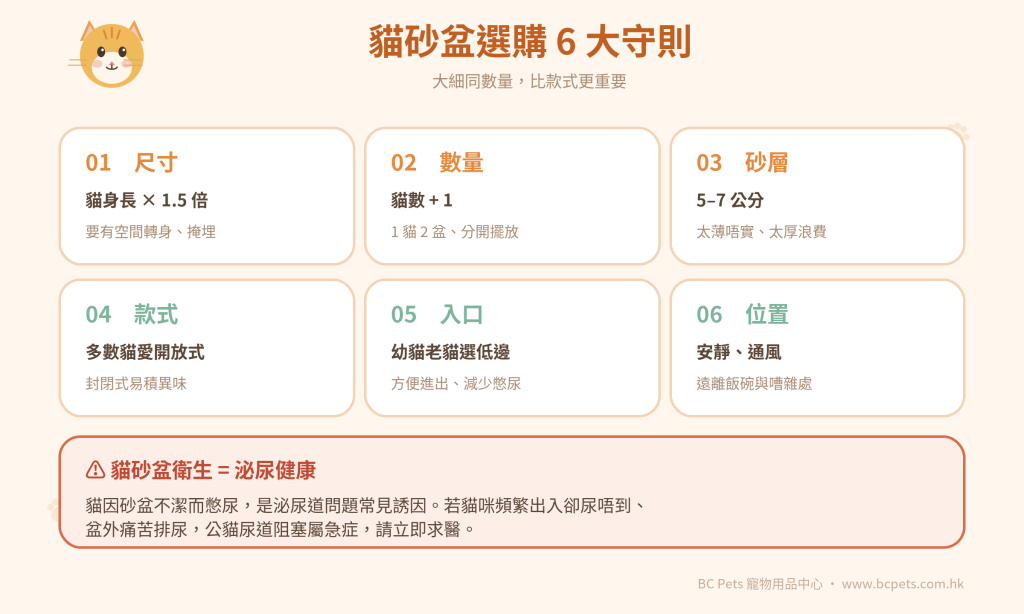
- Litter box quantity rule: number of cats + 1, so 1 cat should have 2 boxes; the box should be about 1.5 times the cat’s body length.
- Litter depth: keep it at about 5–7 cm — too thin and clumps do not hold, too thick is wasteful.
The most beginner-friendly option is tofu cat litter — flushable in small amounts, lightweight, and good at odor control, it is the type most Hong Kong cat owners choose. BC Pets stocks many kinds of tofu litter, mineral litter, wood litter, paper litter, and cassava litter, with free delivery across Hong Kong on orders over HK$350.
Key Takeaways (TL;DR):
- “Changing” is not the same as “scooping”: scooping is daily, a full box change is every 2–4 weeks (clumping type) — the two frequencies are completely different.
- Litter type determines change frequency: clumping litter is topped up as you scoop and fully changed periodically; non-clumping litter cannot have urine scooped out, so the whole batch must be changed more often.
- Tofu litter is the Hong Kong mainstream: flushable, lightweight, and good at odor control, but in humid weather it must be sealed to prevent moisture and clumping.
- The litter box should be big enough and plentiful enough: length about 1.5 times the cat’s body, quantity following “number of cats + 1” — this is key to preventing inappropriate elimination.
- Do not use overly scented litter: cats have a keen sense of smell, and a strong fragrance can actually make them avoid the box.
- Litter box hygiene is linked to health: a cat holding its urine because of a dirty box is a common trigger for urinary tract problems — the money saved on litter can easily turn into a vet bill of over a thousand dollars.
Introduction: Most People Ask “How Often to Change Cat Litter,” but It’s the Wrong Question
“How often should you change cat litter?” is one of the most searched questions among Hong Kong cat owners. But this question hides a common misconception — many people assume “changing litter” is one single thing, so they either change it too often (wasting money) or too rarely (a smelly home and a cat that avoids the box).
The truth is: changing litter involves three actions at three different frequencies — “scooping” out waste daily, “changing” the whole box of litter periodically depending on litter type, and “washing” the box clean monthly. Confuse the three and problems follow. The general consensus in the international veterinary community is: scoop daily, fully change clumping litter about every 2–4 weeks, and deep-clean the litter box once a month (see the vet-reviewed guidance from Catster).
And litter box hygiene is not just an odor issue — it is a health issue. Once a cat holds its urine or starts eliminating elsewhere because of a dirty box, it is often a precursor to urinary tract problems — the money you save on litter may cost you a vet visit of over a thousand dollars. BC Pets Supplies Centre has operated in Hong Kong since 2009, with our shop in Fanling, and over the years we have matched litter and litter boxes for countless cat owners. This guide breaks down change frequency, a comparison of the six main litter types, and how to choose tofu litter and litter boxes — all tailored to Hong Kong’s humid climate and living conditions.
1. How Often to Change Cat Litter? Count “Scoop, Change, Deep Clean” Separately
To explain it clearly, it is best to break “changing litter” into three actions, each with its own frequency. This is also the most important table in this article, and the one most worth remembering.
| Action | What to do | Frequency | Purpose |
|---|---|---|---|
| Scoop | Scoop out urine clumps and feces, then immediately top up with the same amount of fresh litter | At least once a day (twice is better) | Control odor, keep it clean, monitor your cat’s health |
| Change | Pour out the whole box of old litter and refill with fresh litter | Depends on litter type (see table below) | Remove accumulated bacteria and residual odor |
| Deep clean | Empty the box, scrub it thoroughly with mild soap, and air-dry | About once a month | Remove the greasy film, urine scale, and bacteria on the box |
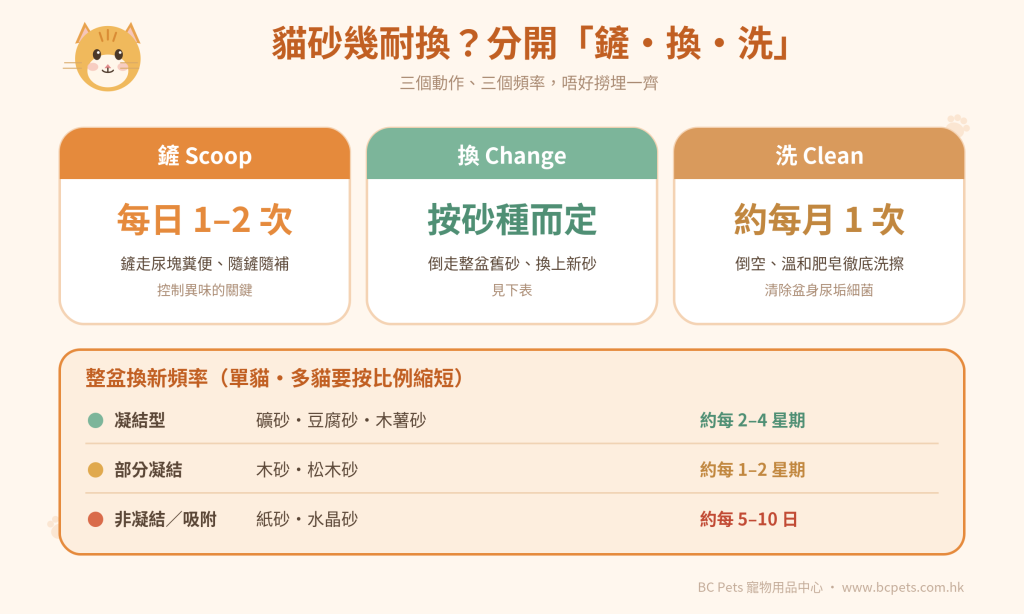
How often you fully change the box depends mainly on whether the litter is “clumping.” Clumping litter lets you scoop out urine every day, so the base litter is used up more slowly and the full-change cycle is longer; non-clumping litter cannot have urine scooped out, so the urine soaks into the whole batch, meaning the whole batch must be changed more frequently.
| Litter type | Clumping? | Full-change frequency (single cat) | Notes |
|---|---|---|---|
| Mineral (bentonite) | Clumping | About every 2–4 weeks | Scoop daily, top up as you go |
| Tofu litter | Clumping | About every 2–4 weeks | Flushable in small amounts; guard against moisture in humid weather |
| Cassava / corn litter | Clumping | About every 2–4 weeks | Naturally biodegradable |
| Wood / pine litter | Partly clumping | About every 1–2 weeks | The crumbling type needs a double-layer box; the clumping type lasts longer |
| Paper litter | Mostly absorbent | About every 5–10 days | Once saturated, the whole batch must be changed |
| Crystal litter (silica gel) | Non-clumping | About every 2–4 weeks (scoop feces diligently) | Absorbs urine and locks in odor, but cannot encase feces |
Tip: The above are reference frequencies for a “single cat.” Multi-cat households should shorten them proportionally — a box shared by two cats needs to be fully changed about twice as often. The most practical way to judge whether a change is needed is “whether there is an obvious odor when you approach the box” and “whether clumping litter is starting to fall apart no matter how you scoop and sticking to the bottom.” Once you smell it, or clumps start to crumble when scooped, that is the signal to do a full change — no need to rigidly follow the calendar.
2. Comparing the Six Main Cat Litter Types: Mineral, Tofu, Wood, and Paper Each Have Trade-Offs
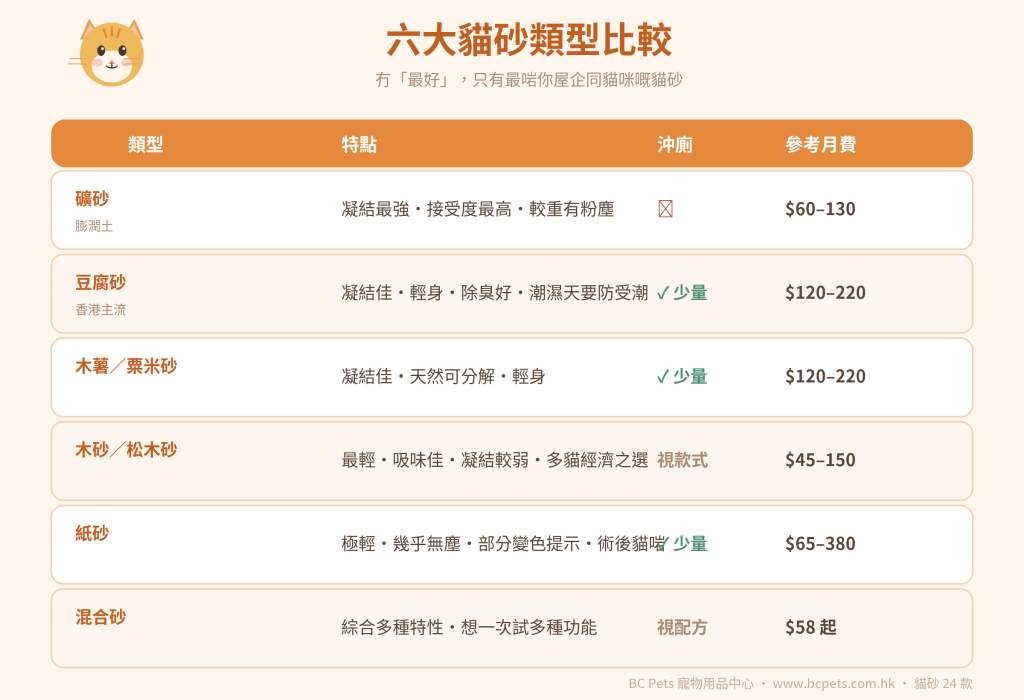
Cat litter on the Hong Kong market falls mainly into six categories. There is no single “best” litter — only the one that best suits your home environment and your cat’s preferences. Here is the full comparison.
| Type | Clumping / Odor control | Flushable? | Dust / Weight | Reference monthly cost | Best for |
|---|---|---|---|---|---|
| Mineral (bentonite) | Strongest clumping, good odor control | No | Heavier, some dust | HK$60–130 | Widest acceptance, budget-first |
| Tofu litter | Good clumping, good odor control | Flushable in small amounts | Lightweight, low dust | HK$120–220 | Hong Kong mainstream, want easy flushing |
| Cassava / corn litter | Good clumping, natural | Flushable in small amounts | Lightweight | HK$120–220 | Those wanting natural and biodegradable |
| Wood / pine litter | Good odor absorption, weaker clumping | Depends on the type | Lightest, low dust | HK$45–150 | Multi-cat households, economical choice |
| Paper litter | Absorbent, some change color as an indicator | Flushable in small amounts | Extremely light, almost dust-free | HK$65–380 | Post-surgery cats, cats with respiratory sensitivities |
| Mixed litter | Combines multiple properties | Depends on the formula | Medium | HK$58– | Those wanting to try several properties at once |
BC Pets’ cat litter section currently has 24 products covering all six categories, including tofu litter, mineral litter, wood litter, corn / cassava litter, paper litter, and mixed litter, with brands including Litomon (怪獸部落), 汪喵星球, Papai (巴派), Cat’s Best, and more.
Tip: Do not choose “overly scented” litter. A cat’s sense of smell is far keener than a human’s, and a strong fragrance can be irritating or even off-putting to it, causing it to refuse to use the box. Truly good odor control should come from the litter’s own absorption / clumping ability, not from masking with fragrance. If you are unsure which litter your cat likes, the safest approach is to buy a small pack of each to test — cats can be very stubborn about litter preferences, and the wrong switch may lead to a litter-box strike.
3. How to Choose Tofu Cat Litter? Hong Kong’s Most Popular Type, but It Has Pitfalls Too
Tofu cat litter has been Hong Kong’s most popular type in recent years — 15 of BC Pets’ 24 cat litters are tofu litter or tofu blends. Its advantages are clear: made from soy fiber, it is natural and eco-friendly, lightweight, good at odor control, and flushable in small amounts, making it much easier to handle than mineral litter. But there are a few things to watch when choosing tofu litter.
| Buying consideration | Explanation | Recommendation |
|---|---|---|
| Pellet shape | Commonly “strip-shaped” and “rice-grain-shaped” | Rice-grain shape tracks less and feels finer; strip shape clumps faster — test by your cat’s preference |
| Clumping speed | Affects how hard it is to scoop and whether it falls apart | Choose types marked “instant / strong clumping” |
| Coarseness (mm) | 2mm is finer with a nicer texture; coarser tracks less | Fine litter has high acceptance from cats but may be tracked out of the box more easily |
| Flush-friendliness | Tofu litter is flushable but in moderation | Flush a small amount each time to avoid clogging the drain all at once |
| Added functions | Probiotic odor control, pheromone soothing, urinary occult-blood detection | Choose as needed; occult-blood litter can detect blood in urine early |
It is worth mentioning that some tofu litters add a urinary health detection (occult-blood) function that changes color when the urine contains trace amounts of blood, helping detect a cat’s urinary tract problems early — especially useful for middle-aged and senior cats or those with a history of urinary issues. You can find these products in the tofu litter category.
Tip: Tofu litter’s biggest enemy is Hong Kong’s humidity. If stored improperly after opening, the whole bag will absorb moisture, clump, and lose its clumping power — a total waste. The right approach: after opening, pour it into a sealed bin or clip the bag tightly shut, and keep it in a cool, dry place, away from windows or the bathroom. Also, “flushable” does not mean you can dump a big pile down the toilet at once — always flush a small amount at a time, especially in older buildings with narrow drains, where taking a shortcut can clog the pipe.
4. How to Choose a Litter Box? Size and Quantity Matter More Than Style
Many people choose a litter box based only on how nice it looks and how little space it takes, but for the cat, the box’s size and quantity matter most. The wrong box is the number-one cause of a cat eliminating inappropriately or refusing to use it.
| Consideration | Recommended standard | Reason |
|---|---|---|
| Length | About 1.5 times the cat’s body length (excluding the tail) | The cat needs enough room to turn around and bury |
| Quantity | Number of cats + 1 (1 cat → 2 boxes, 2 cats → 3 boxes) | Avoids resource competition and provides choice |
| Litter depth | About 5–7 cm | Too thin and clumps do not hold; too thick is wasteful and easily tracked out |
| Open vs covered | Most cats prefer open boxes | Covered boxes trap odor easily and feel confining to some cats |
| Entry height | Choose low-sided boxes for kittens / senior cats | Easy to get in and out, reducing urine-holding |
| Location | Quiet, well-ventilated, away from the food bowl | Cats dislike toileting in noisy places or near food |
Accessories also help: a litter mat reduces tracking out of the box, and a litter scoop with the right hole spacing makes scooping easier. You can find all of these in BC Pets’ litter box / toilet category and pet toileting supplies.
Tip: The “number of cats + 1” rule is worth following seriously. Many people keep two cats but provide only one box, and one of them ends up chronically holding its urine or being “box-guarded” by the other and afraid to use it, eventually triggering urinary problems or inappropriate elimination. The cost of one extra box is far lower than a single urinary-tract vet visit. And multiple boxes are best placed in different rooms or spots, not side by side — side by side counts as “one toilet” to a cat and defeats the purpose of spreading them out.
5. Hong Kong’s Humid Environment: Storage, Odor Control, and Placement
Hong Kong has high humidity year-round, especially in summer, and this has a real effect on how litter performs. Humidity makes tofu litter and cassava litter absorb moisture and clump prematurely, and also speeds up odor. Here are practical measures tailored to the local climate.
| Problem | Cause | Solution |
|---|---|---|
| The whole bag of litter absorbs moisture and clumps | Absorbs air humidity after opening | Use a sealed bin / clip the bag tight, keep it in a cool, dry place |
| Strong odor from the litter box | Heat and humidity speed up bacterial breakdown of urine | Scoop more often, deep-clean the box monthly, use a pet-specific deodorizer |
| Damp litter box during “return of spring” humidity | Extremely high ambient humidity | Add a dehumidifier, choose highly absorbent litter, change litter more often |
| Decreased clumping power | The litter has absorbed moisture | Moisture-affected litter should be fully changed; do not keep using it |
For odor control, choose fragrance-free or lightly scented pet-specific deodorizers to avoid irritating the cat. Related products are in household cleaning / pest control / deodorizing supplies.
Tip: Another common Hong Kong safety reminder: wood litter, paper litter, and crystal litter are all flammable, so store them away from fire sources and stoves. Even BC Pets’ product descriptions note this specifically. In addition, during “return of spring” / humid seasons, consider temporarily increasing scooping and change frequency, because humidity noticeably worsens odor and clumping problems.
6. Save Money While Staying Hygienic: Usage, Case Discounts, and Health Monitoring
Cat litter is a fixed monthly expense, and the key to saving money is not buying the cheapest, but “using it right and buying it smart.” Here are three practical directions.
| Money-saving method | How to do it | Watch out for |
|---|---|---|
| Buy by the case / in multipacks | Buying a full case (e.g. a 6-pack) at once lowers the unit price | Make sure you have dry space to store it and avoid moisture |
| Maintain the right litter depth | 5–7 cm is enough; do not pour it too thick | Too thick is both wasteful and easily tracked out of the box |
| Meet the free-shipping threshold | Free delivery across Hong Kong on orders over HK$350 | Combine cat food and supplies in one order to meet the threshold |
| Make good use of the sale section | Near-expiry or damaged-bag deals are perfectly fine in quality with big discounts | Suitable for multi-cat households that use up litter quickly |
| Choose health-monitoring litter | Occult-blood detection litter can spot blood in urine early | Saves the high medical cost of delayed treatment |
Buying litter together with cat food is the easiest way to meet free shipping — you can also check out natural cat food and urinary tract health supplements. Portions can be worked out with the Pet Feeding Portion Calculator.
Tip: The most overlooked way to save money is actually “choosing a litter your cat will use.” If you cheap out and buy a litter your cat dislikes, it refuses the box and eliminates elsewhere, and you not only have to buy new litter but also spend time cleaning up and possibly face urinary problems — ending up more expensive than getting it right the first time. So for a first-time cat owner, it is better to buy a few small packs to test first, find the type your cat accepts, and then buy by the case to save money.
Frequently Asked Questions (FAQ)
How often should I change cat litter?
Split it into three things: “scoop” out urine clumps and feces daily (at least once, twice is better); a full “change” depends on litter type — clumping types (mineral, tofu, cassava) about every 2–4 weeks, non-clumping types (paper, some wood) about every 5–10 days; and deep “clean” the box once a month. Multi-cat households should shorten the frequency proportionally. The most practical way to judge is: once you smell an obvious odor, or clumping litter starts to fall apart no matter how you scoop and sticks to the bottom, that is the signal for a full change — no need to rigidly follow the calendar.
Is tofu cat litter good? What should I watch out for?
Tofu cat litter is Hong Kong’s most mainstream type, with the advantages of being natural and eco-friendly, lightweight, good at odor control, flushable in small amounts, and easy to handle. Three things to note: first, Hong Kong is humid, so seal it after opening to prevent moisture and clumping; second, “flushable” means a small amount at a time in stages, especially in older buildings with narrow drains, where a large amount at once will clog the pipe; third, when buying, note the pellet shape (strip / rice-grain) and clumping speed, and avoid types with too strong a fragrance. 15 of BC Pets’ 24 cat litters are tofu litter or tofu blends, so there is plenty of choice.
How many litter boxes should I buy? How do I choose the size?
Quantity follows the “number of cats + 1” principle: 1 cat should have 2 boxes, 2 cats should have 3, placed in different spots rather than side by side. For size, the box length should be about 1.5 times the cat’s body length (excluding the tail) so the cat has room to turn around and bury. Keep litter depth at 5–7 cm. Most cats prefer open boxes; covered boxes trap odor easily and feel confining to some cats. Kittens and senior cats should have low-entry boxes for easy access. The box location should be quiet, well-ventilated, and away from the food bowl.
Which cat litter is cheapest? What’s best for a multi-cat household?
By monthly cost, mineral litter (about HK$60–130) and wood / pine litter (about HK$45–150) are usually the most economical, suitable for the heavy use of a multi-cat household. But “cheapest” does not equal “best value” — if your cat refuses to use it, the waste is greater. The practical advice for multi-cat households: first confirm the type your cats accept, then buy by the case to lower the unit price; and remember that multiple cats require proportionally higher change frequency and more boxes. Many of BC Pets’ litters have case discounts (such as a 6-pack) with a lower unit price than buying singly.
Can cat litter be flushed down the toilet?
Only some can, and only in moderation. Tofu litter, cassava litter, and some paper litters are marked as flushable, but you must flush a small amount at a time in stages, never a large amount down the toilet at once — especially in Hong Kong’s older buildings with narrow drainpipes, which clog easily. Mineral (bentonite) litter and crystal litter absolutely cannot be flushed; they swell and set on contact with water and will block the drain solid, so they can only be thrown out with the rubbish. Before flushing, check the packaging label and consider your home’s drainage — to be safe, in most cases we recommend disposing of it with the rubbish.
Why did my cat suddenly stop using the litter box?
The most common reason is that the box is not clean enough or there are not enough boxes. Cats have high hygiene standards, and a box with odor, insufficient scooping, or multiple cats sharing one box can all make a cat refuse it or even eliminate elsewhere. Other reasons include: switching to a new litter it dislikes (especially too strong a fragrance), a box location that is too noisy or near the food bowl, or a box that is too small or has too high an entry. But note especially: if your cat suddenly goes in and out of the box frequently but cannot urinate, or urinates painfully outside the box, it may be a urinary tract disease (urethral blockage in male cats in particular is an emergency), and you should seek a vet immediately rather than treating it as just a behavioral problem.
What should I do about litter box odor?
Start on three fronts: first, scoop more often — at least once a day, and immediately whenever there is a smell; second, switch to litter with stronger clumping and odor control (such as quality mineral or tofu litter) and ensure the litter depth is enough (5–7 cm); third, empty the box once a month and scrub it thoroughly with mild soap to remove urine scale and the greasy film on the box. Avoid using strongly scented products to mask the odor, as this can instead put the cat off. Odor worsens in Hong Kong’s humid season, so pair it with a dehumidifier and pet-specific deodorizers. If odor persists despite proper cleaning, watch out for a health problem in your cat.
Limitations and disclaimer: The change frequencies listed here are general references; the actual needs depend on litter type, number of cats, individual cat habits, and Hong Kong’s humidity. Prices are BC Pets’ online prices as of July 2026 and may vary by style, specification, and limited-time offers — the product page display prevails. This article is general pet-care information and does not constitute a veterinary diagnosis or treatment advice. If your cat has difficulty urinating, goes in and out of the box frequently without producing urine, has blood in its urine, urinates painfully outside the box, or shows lower energy and appetite, please consult a registered veterinarian immediately — urethral blockage in male cats is an emergency and can be fatal if delayed. The change frequencies cited are drawn from publicly available internationally vet-reviewed sources and reflect the general consensus as of July 2026. If you find any information here to be wrong or out of date, please call +852 2683-0318 (daily 10:00–21:30) or WhatsApp +852 5544-7400 to let us know, and we will verify and update it.
Conclusion: The Three Core Principles of Cat Litter Management
This entire guide can be distilled into three sentences:
- Count “scoop, change, deep clean” separately. Scoop daily, fully change clumping litter about every 2–4 weeks, and deep-clean the box monthly. Break “how often to change cat litter” into three actions and you will never again change it too often or too rarely.
- Choose litter for your cat, not by price. Tofu cat litter is very common in Hong Kong, but ultimately it comes down to whether your cat will use it. Test small packs first, find the type it accepts, then buy by the case to save money; avoid overly scented litter.
- The litter box should be big enough and plentiful enough. Length about 1.5 times the cat’s body, quantity following “number of cats + 1,” litter depth 5–7 cm. Litter box hygiene is directly tied to your cat’s urinary health, and cutting corners here can easily backfire.
Cat litter may seem like a small matter, but it is a big deal that affects your cat’s health and your home’s smell every day. Manage it well and both you and your cat live more comfortably.
Ready to Switch Your Cat to a Litter That Suits It?
BC Pets Supplies Centre has served furkid families in Hong Kong since 2009, with our shop at Shop A8, G/F, Flora Plaza, 88 Pak Wo Road, Fanling, New Territories, and we also offer online and phone ordering. All items we sell are guaranteed to be genuine Hong Kong-authorized goods, with free delivery across Hong Kong on orders over HK$350, plus cash-voucher rebates.
Shop now: All Cat Litter (24 products)|Tofu Cat Litter|Litter Boxes / Toilets|All Pet Toileting Supplies. Not sure which litter your cat likes? Call 2683-0318 or WhatsApp 5544-7400, and we will recommend a suitable option based on your cat’s situation.
Further reading: Choosing Natural Cat Food|Urinary Tract Health Supplements|Pet Feeding Portion Calculator|About BC Pets
Disclosure of Interest: This article was written by BC Pets Supplies Centre (www.bcpets.com.hk). BC Pets is a registered Hong Kong pet-supplies and pet-food retailer that has operated since 2009. The categories of cat litter, litter boxes, and related toileting supplies mentioned in this article are all sold in our shop, and we profit from the related sales. To maintain the credibility of our content, our approach is: change-frequency and hygiene advice is cited from publicly available internationally vet-reviewed sources with the source noted; product information and prices follow what is actually displayed on BC Pets’ product pages. We also state honestly several facts that do not favor selling high-priced products, including: there is no “best” litter, only the most suitable one; overly scented litter can actually put a cat off; the cheapest litter is more wasteful if the cat will not use it; and some cat litters cannot be flushed. The buying advice here is professional judgment based on more than a decade of local experience, not aimed at pushing any particular product. This article does not constitute a veterinary diagnosis or treatment advice.