Fat Cat Weight-Loss Campaign! (Cat Weight Management)
We humans know how to plan for the future, preparing for the long life challenges ahead. So… let’s not look too far ahead; let’s look a little closer. Well, it’s that kitty in your home who loves to stick close to you and loves to jump around — isn’t it so cute and adorable? So will you also prepare for your cat’s long-term health? Actually, you can prepare for your kitty’s health too!
What we want to talk about this time is a kitty’s weight. “Hmm… my cat is nice and fleshy, so nice to cuddle, right? Why do I need to control its weight?!” you might think… But when you consider that obesity problems in a kitty can potentially lead to arthritis, diabetes, certain cancers and many more adverse conditions, wouldn’t you want to learn a bit more?
Let’s explore together the issue of a kitty’s weight…
As cat servants, of course we want our feline masters to be healthy. But it turns out that behind a plump, chubby kitty, when its weight keeps climbing… there may be the following risks:
– Arthritis and increased joint strain
– Diabetes
– High blood pressure
– Heart disease
– Skin problems
– Certain cancers
– A shorter lifespan (Oh No! That’s bad!)
It turns out that a big fat kitty has a relatively higher chance of developing diabetes, and just like humans, if it has this illness it may need insulin injections for life. Also, you can imagine that when a kitty bends over and its own big belly gets in the way, even licking itself clean becomes difficult… let alone being as nimble as it was when it used to be slim… (laugh) So we think that a kitty having a fit figure — apart from entering a bodybuilding-kitty contest — may also affect its mood!
So what counts as normal?
We can refer to the BCS (Body Condition Score). The BCS is generally divided into 1-9 points: 1 point is skin and bones, and 9 points is… imagine the bloated look of the comic character GARFIELD after a big meal… As for the standard, 4.5-5 points is the most ideal! That is, the middle, leaning slightly towards the lean side.
We can do 2 things:
1… First, look: we look at the kitty’s figure from directly above, and also from the side. Then look at the illustration below and you’ll get a rough idea.
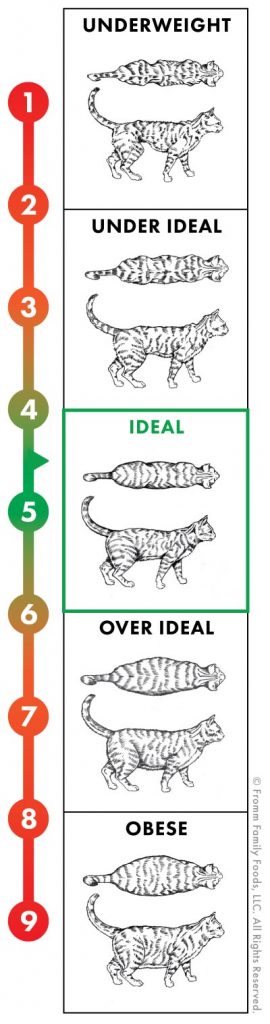
2… Then use your hands to feel the kitty’s breastbone area, behind the kitty’s shoulder blades. If you can easily feel the kitty’s bones, that’s the standard. Also, you can notice whether you can find (or see) the kitty’s slim waist… If you feel soft… thick flesh (fat)… and can’t find its slim waist… then the kitty may have an overweight problem… Of course, we’re not vets, and if you need a professional analysis, we’d recommend taking your kitty to ask a vet’s opinion. This article pulls together some suggestions and cannot replace a vet’s diagnosis, so please keep that in mind!
If you feel your kitty may have a bit too much baby fat… then you can consider the following suggestions:
How do you help it lose weight?
Vets usually recommend a slow weight-loss process, roughly losing 1% of body weight per week. That is, if the kitty weighs 15 pounds (about 7 kg), losing 70-80 grams per week is most ideal.
* But please note, excessive dieting will bring even worse effects on your kitty!
Hepatic lipidosis (fatty liver syndrome) is very common in overweight cats that suddenly stop eating. It occurs when stored body fat breaks down too quickly… this places too much burden and damage on the liver. This extreme physical condition, if treated promptly, has no major adverse effects, but no cat servant wants to see their kitty in this situation! Actually there’s no need to worry too much… if weight loss is done in an orderly way, it does the fat kitty nothing but good!
In summary, taking your fat kitty to see a vet and then feeding the weight-loss diet the vet recommends is best and usually won’t go wrong; but we can also start from fundamental eating habits to help the kitty lose weight! The simplest is to switch normal cat food to weight-loss food, rather than reducing the feeding portion, because reducing the portion actually leaves the kitty without enough nutrition, with an empty tummy, and its sense of wellbeing drops too! Before starting the weight-loss diet, first try to record how many meals the fat kitty eats a day, and how much food and treats in total. Treats, just like our human snacks, please the mouth but not the belly! Best to eat little for more enjoyment! And with the basic information you can more effectively work out how to help the fat kitty lose weight!
We’ll also introduce 2 fairly popular weight-loss foods… (Can’t help it… give us a hand and promote them… or forward this to cat-servant friends in need… thanks…)
Orijen Fit and Trim Weight-Loss Formula (All Life Stages Cat Food) 1.8kg (about 4 pounds)
Oven-Baked Tradition Senior Cat Weight-Loss Formula 10lbs
Quality of Life is also an important part of weight loss for a fat kitty. Food and exercise — missing either one will put a dent in the weight-loss plan… Kitties love to sleep, and that won’t change… but as a cat servant, you should arrange more exercise for your master! For example:
- Your kitty’s favourite toy — let the kitty move around more! (For example, glowing toys; kitties generally love chasing the light spot.) If time permits, playing more with your master creates a better bond!
Introducing… cat toys - Buy some automatic cat toys so the kitty can chase and run around (especially suitable for cat servants who don’t have much time to play with their master)
- Buy a “cat tree” that kitties love to climb, put a treat the kitty likes at the top, and let it jump or climb up to eat it.
- Kitties also have a hunting instinct, so hiding a small amount of treats around the home (really just a little…) and letting it use its instinct to find its beloved treats is a good method too!
Maintaining a Fit Figure
When the kitty slims down to 4.5-5 points, you may notice the fat kitty’s coat has a better shine, its belly is smaller, and the kitty can even groom its own fur again. Whether kitty or cat servant, everyone should be in a better mood! We hope you and your kitty can keep at it and work towards the kitty’s long-term health!
Finally, also consider: is your kitty overweight due to a health condition? Illnesses that cause weight gain (such as hormonal imbalance) are less common in cats than in dogs, but they still occasionally happen. To rule out conditions that can be treated with medication, your vet may recommend a blood test before starting the weight-loss plan. Our advice is: follow the vet’s opinion!
We hope all cat servants will work hard to win this battle for their master’s health!
Your Pet Supplies Centre,
BC Pets