A Complete Guide to Applying for and Renewing a Hong Kong Dog Licence

  • Post last modified:2026-08-29
  • Post category:Pet Encyclopedia

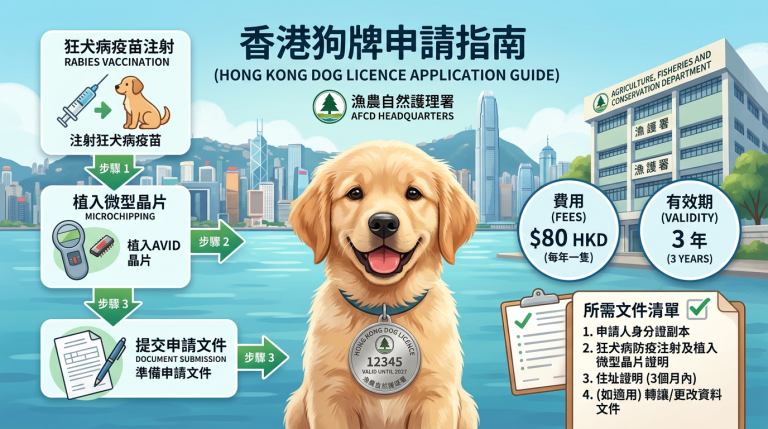
Hong Kong dog licences are issued by the Agriculture, Fisheries and Conservation Department (AFCD). All dogs aged 3 months can be vaccinated, microchipped and licensed, and the first application must be completed before they turn 5 months old; the licence is valid for 3 years. Dog Licence Application Process From 3 months of age a dog can be given the rabies vaccination, implanted with a microchip and licensed, and this must be done before it turns 5 months old. No appointment is needed — you can attend an AFCD district Animal Management Centre, a vaccination and licensing station, a private veterinary clinic or an SPCA centre. Steps at a glance: Bring your dog and the required documents to the service location in person. Have the vaccination given on-site (first-time or renewal) and the microchip implanted (first-time). After paying the $80 fee (AFCD service), collect the dog licence on the spot or by post. If you apply online, bring your dog to a centre for verification within 14 days, providing the application reference number. Service locations (Animal Management Centres across Hong Kong, open on Sundays and public holidays): New Territories North:上水石湖墟馬會道13號(2672 4563) New Territories South:沙田多石徑11號(2691 2269) Kowloon:啟德承佑街16號(2362 6988) Hong Kong Island:域多利道688號(2550…

Continue ReadingA Complete Guide to Applying for and Renewing a Hong Kong Dog Licence

Hong Kong Pet-Friendly Estates Database

  • Post last modified:2026-08-22
  • Post category:Pet Encyclopedia

In Hong Kong, where space is scarce and people are many, pet owners often find that a building's Deed of Mutual Covenant strictly bans keeping cats and dogs, turning house-hunting and renting into a real headache when you don't know how to find a suitable place. That's why we've built this Hong Kong pet-friendly estates database — to help furkid parents quickly narrow down the estates and buildings where cats and dogs are allowed, so the whole family, furkids included, can settle in happily and comfortably. Using the interactive drop-down menus, you can browse over a hundred up-to-date listings by region and sub-district — covering Hong Kong Island, Kowloon, and the New Territories — for easy searching. This database brings together information from various sources — not only solving the problem of there being no central database, but also promoting a pet-inclusive way of life, so that more families in Hong Kong can live in their ideal home without the worry. Sources and Recommendations This database is compiled mainly from publicly available online information and reliable sources; it is not an official central database. Before relying on it, users must personally check the building's Deed of Mutual Covenant or contact…

Continue ReadingHong Kong Pet-Friendly Estates Database

How long can a dog hold it before it poops? Do you even know that?

  • Post last modified:2026-07-17
  • Post category:Pet Encyclopedia

Nowadays, with people living at such a fast pace and busy commuting to work or going out to work, sometimes I worry whether leaving my dog at home for so long might cause it to poop urgently. So the question arises: how long can dogs actually hold their pee? What is the relationship between their poop habits and their health status? This time, we'll explain everything clearly so you can be more confident in caring for your furry friend! 🕒 How long can an adult dog generally go without pooping? Most healthy adult dogs usually want to go to the bathroom about an hour after eating. But if they really have to endure, they can actually hold out for 12 hours or even longer. That means even if you're stuck in traffic or work late, it doesn't mean something will happen right away. But keep in mind: just because your dog can hold it doesn't mean they're comfortable. Think about how tough it is to be unable to find a bathroom in a hurry. Dogs can also struggle, but they don't know when you'll come back and let them out. If you always have to be out for long periods,…

Continue ReadingHow long can a dog hold it before it poops? Do you even know that?

Dog Care Tips: Understanding Dog Behaviour and Body Language

  • Post last modified:2015-11-25
  • Post category:Pet Encyclopedia

dogDid you know that many of the things dogs do actually carry a specific meaning? Here are some classic pieces of canine body language:


1. Sniffing the ground: this is thought to be a calming signal, used when a dog is afraid of the other party (person or dog) and wants to settle them down.


2. A quick turn of the head, looking or glancing away. Sometimes it happens in an instant and you may not even notice it. When a child runs towards a dog to hug it, a frightened dog may well do this.


So do remind children never to approach a strange dog that is staring at them; in canine body language, "staring at you" signals aggression. And of course, children should not be allowed to approach strange dogs freely unless an adult is there to supervise.


3. Licking its own nose: whether quickly or slowly, this is thought to be a signal to calm an unfamiliar party. Interestingly, black dogs use this gesture more often than dogs of other colours, probably because their facial expressions are harder to make out, while a pink tongue really stands out.

Continue ReadingDog Care Tips: Understanding Dog Behaviour and Body Language

Dog Care Knowledge: How often should dogs be bathed?

  • Post last modified:2026-07-17
  • Post category:Pet Encyclopedia

Dog takes a showerIn summer, the dog's body odor also gets stronger. Although in winter you might only bathe your furry friend once a month, in summer, the strong dog smell they give off may require bathing once a week.


However, there is no absolute strict rule on how often dogs should be bathed; the frequency of bathing can vary greatly among dogs.

How often should your dog be bathed?

Continue ReadingDog Care Knowledge: How often should dogs be bathed?

Dog Care Tips: What to Do When Your Dog Gets Menstruating?

  • Post last modified:2015-08-17
  • Post category:Pet Encyclopedia

dog menstruationDog women are just like women—they always experience those days of feeling especially irritable, impatient, and unexplainably restless. Menstruation has a physiological impact on the dog, and it also brings changes in its mental state. Physiologically, it can cause menstrual bleeding, mental irritability, and affect their appetite!


1. Menstruation brings changes to dogs

1. The timing of menstruation

Each dog's menstruation period varies greatly and is closely related to their usual eating habits. Normally, this period is around 6-8 months, but if a dog eats dog food, it usually lasts around 8-10 months.

Continue ReadingDog Care Tips: What to Do When Your Dog Gets Menstruating?

Breed Introduction: Miniature Schnauzer

  • Post last modified:2026-07-17
  • Post category:Pet Encyclopedia

Miniature SchnauzerBreed Introduction: Miniature Schnauzer


Country of origin: Germany


Appearance Features:


The Mini-Snasha is a very unique breed. It has a broad and sturdy body, a coarse grayish-white coat, a rectangular head covered with thick eyebrows like an elder's, and a particularly full mustache, giving it a strange yet adorable appearance. Although small in size, it is short and lean, with powerful movements, and only a small part of its tail remains. The area from the top of his head to the rounded, blunt tip of his nose only slightly slopes downward, and the thick beard-shaped mouth and face form his distinctive Snasha look.


Continue ReadingBreed Introduction: Miniature Schnauzer