Quick answer: When buying dog food in Hong Kong, check these 5 things – (1) confirm it meets AAFCO or FEDIAF nutritional standards, (2) a named meat sits first on the ingredients list, (3) protein content is no lower than 25%, (4) the formula matches your dog’s age, and (5) you are buying genuine stock through an authorised channel. According to 6W Research, Hong Kong’s pet care products market keeps expanding at a compound annual growth rate of 7.3%, with consumers shifting from price-driven to quality-driven buying.
Key Takeaways TL;DR
- Certification first: choose brands that meet the nutritional standards of AAFCO (Association of American Feed Control Officials) or FEDIAF (European Pet Food Industry Federation)
- Read the ingredients: a named meat should come first (such as “fresh chicken”), protein should be at least 25%, and avoid products containing BHA/BHT preservatives
- Match the age: puppies need high protein (28%+), adult dogs need a balanced formula (25%+), senior dogs need low fat + joint support
- Hong Kong’s climate: average annual humidity is 78%, so finish dry food within 4-6 weeks of opening and store it in a sealed container in a cool spot
- Top 10 brand recommendations: Orijen (highest protein), Acana (best value), Wellness CORE, Now Fresh and more
With hundreds of dog foods on the shelves in Hong Kong, how to choose dog food is the first hurdle many new dog owners face. Hong Kong statistics put the local pet industry market size at HK$6.2 billion, with eight out of ten dog owners surveyed saying they will spend more on their pets in future – which means more quality brands entering the market, but also an even harder choice.
This guide is written by the team at BC Pets (rooted in Hong Kong since 2009), drawing on years of serving local dog owners to set out the most practical framework for choosing food. Whether you have just welcomed a new pet home or you are an experienced owner looking to upgrade your dog’s diet, you will find the answers here.
Point 1: Confirm the Nutritional Standard Certification (AAFCO / FEDIAF)
AAFCO (Association of American Feed Control Officials) is the American body that sets nutritional standards for pet food, founded in 1909. A dog food that meets AAFCO standards has had its formula verified through feeding trials or nutritional analysis, and can provide complete, balanced nutrition for your dog.
In Europe, the main standard is FEDIAF (Federation Europeenne de l’Industrie des Aliments pour Animaux Familiers, the European Pet Food Industry Federation). Both sets of standards are recognised by the international veterinary community.
Practical tip: When buying dog food, look for the words “Complete and Balanced” printed on the packaging, along with the life stage it suits (Growth for puppies / Maintenance for adults / All Life Stages). This is the quickest way to tell whether a dog food is up to standard.
Point 2: Read the Ingredients List – Meat Must Come First
Dog food ingredients are listed by weight, from highest to lowest – the first ingredient makes up the largest share. In a quality dog food, the top 3 should be named animal proteins, such as “deboned chicken” or “fresh salmon”, rather than vague terms like “meat by-products” or “animal meal”.
Ingredients List Quick Reference
| Nutrient | Recommended range | Below standard | Why it matters |
|---|---|---|---|
| Crude protein | ≥25% (puppies ≥28%) | <20% | The foundation for muscle development and immune function |
| Crude fat | 12-18% | <8% or >22% | Provides energy and keeps the skin and coat healthy |
| Crude fibre | ≤5% | >7% | Aids digestion, but too much points to a lot of filler |
| Moisture | ≤10% (dry food) | >12% | Excess moisture means lower actual nutrient density |
| Omega-3/6 | Better if stated | Not stated | Skin and coat shine |
What to avoid: Steer clear of dog foods containing any of the following – BHA / BHT (artificial preservatives), artificial colours (such as Red 40 and Yellow 5), propylene glycol, and excessive corn syrup or sugar. If your dog has skin problems, consider switching to a single-protein formula (such as pure lamb or pure fish) to rule out allergens.
Point 3: Choose the Right Formula for Your Dog’s Age
A dog’s nutritional needs vary a great deal across life stages. Choosing the wrong formula is not just a waste of money – it can affect your pet’s health. Here is an age-matching guide based on veterinary nutrition advice:
Puppies (0-12 months)
- Protein ≥28%
- Fat ≥17%
- Contains DHA to support brain development
- Calcium-to-phosphorus ratio 1:1 to 2:1
- Feed 3-4 times daily
Adult dogs (1-7 years)
- Protein ≥25%
- Fat 12-18%
- Balanced vitamins and minerals
- Calories controlled by body weight
- Feed twice daily
Senior dogs (7 years and above)
- Protein ≥25% (maintains muscle)
- Fat ≤12% (controls weight)
- Contains glucosamine (joint care)
- Easy-to-digest formula
- Feed 2-3 times daily (smaller portions)
Expert advice: Large breeds (such as Golden Retrievers and Labradors) have a longer puppy stage, so we recommend feeding a large breed puppy formula until 18 months. Small breeds (such as Poodles and Chihuahuas) can usually move to adult food at around 10-12 months. If you are not sure when to switch, see our puppy food switching guide.
Point 4: Storage Tips for Hong Kong’s Climate
Hong Kong’s average annual relative humidity reaches 78% (according to Hong Kong Observatory data), and often tops 90% in summer. This kind of damp environment is a breeding ground for spoilage and mould in dry food. Storing food properly protects its quality, and it is something to factor in when you buy.
5 storage essentials:
(1) Keep the original packaging – put the whole original bag inside a sealed container (do not pour the food out), because the inner lining of the original bag usually has a coating that stops the fats oxidising. (2) Store somewhere cool – keep it out of direct sunlight and away from the stove. (3) Finish within 4-6 weeks of opening – beyond that, nutrients are lost more quickly, though a vacuum-sealed bag can extend this by 1-2 weeks. (4) Avoid repeated temperature swings – taking food in and out of the fridge is not recommended, as the hot-cold cycle easily causes condensation. (5) Check regularly – throw the food out immediately if you notice any off odour, clumping or discolouration.
Buying tip: Hong Kong dog owners may want to buy smaller packs (such as 2kg/4.5kg). The price per kilogram is slightly higher, but it makes sure the food is finished while still at its best. BC Pets offers a range of natural dog foods in small pack sizes.
Point 5: Choose a Genuine Retail Channel
When buying dog food in Hong Kong, a guarantee of genuine stock is essential. Parallel imports and grey market dog food can carry risks including poor storage, expired stock that has been repackaged, and even substituted ingredients. Here is how to tell the genuine article:
3 steps to identify genuine stock: (1) Look for the Hong Kong distributor label on the packaging – properly imported dog food carries a Chinese-language label stating the Hong Kong distributor’s name and contact details. (2) Check the expiry date – make sure there are at least 6 months left before it expires. (3) Compare against the official price – if the price is more than 30% below the market rate, be on your guard.
Reliable buying channels include brand-authorised retailers, pet supply shops with a physical store, and reputable online shops that state they carry genuine Hong Kong retail stock.
10 Dog Food Brands Compared
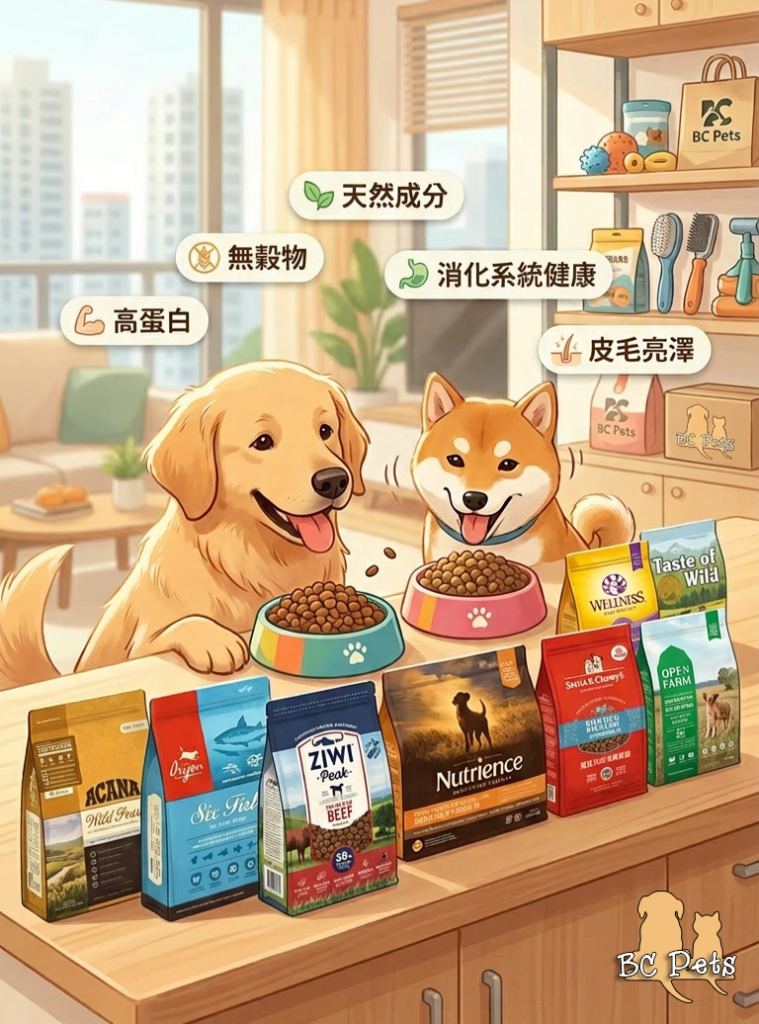
The 10 dog food brands below are all natural, quality brands selected by BC Pets. Every one is genuine Hong Kong retail stock and meets AAFCO or FEDIAF standards. The comparison covers protein content, key features, reference price and the dogs each one suits:
| Brand | Origin | Protein | Key features | HK$ reference price/kg | Best for |
|---|---|---|---|---|---|
| Orijen | Canada | 38% | 85% animal ingredients, biologically appropriate formula | $160-180 | Owners after the highest protein |
| Acana | Canada | 29-33% | Made by Champion Petfoods, excellent value | $110-130 | The value pick |
| Wellness CORE | USA | 34% | Grain-free and high protein, with a weight management range | $120-140 | Dogs that need to watch their weight |
| NOW FRESH | Canada | 32% | Meat-rich formulas, skin + digestion ranges | $100-120 | Dogs with sensitive stomachs |
| Canidae | USA | 24-32% | PURE range single protein, family recipes | $90-110 | Allergy-prone dogs (single protein) |
| Fromm | USA | 26-30% | Family-run for over 120 years, small-batch handcrafted, Four-Star/Gold ranges with plenty of flavours to rotate | $100-120 | Owners who like to rotate flavours regularly |
| Farmina N&D | Italy | 30-37% | Low-grain/grain-free, pumpkin formulas | $110-140 | Fans of European formulas |
| Ziwi Peak | New Zealand | 35-45% | Air-dried process, 96% meat content | $280-350 | Owners after a top-tier natural food |
| K9 Natural | New Zealand | 35-48% | Freeze-dried raw food, BARF philosophy | $250-320 | Supporters of raw feeding |
| Stella & Chewy’s | USA | 35-42% | Kibble coated in freeze-dried raw meat, Raw Coated Kibble technology | $200-280 | Owners curious about raw feeding but wary of the hassle |
*Prices are BC Pets reference prices as of April 2026; actual prices vary by pack size and promotions. All brands are genuine Hong Kong retail stock.
BC Pets recommends: Our top three picks are as follows. Fromm is an American family-run brand of over 120 years, with 26-30% protein, consistent formulas and excellent digestive tolerance (around HK$100-130 per kg), making it a great starting point for first-time dog owners. Wellness CORE takes the grain-free, high-protein route (34-36% protein), with formulas tailored to different ages and body sizes and outstanding value. And if you want your dog to get the benefits of raw nutrition, Stella & Chewy’s Raw Coated Kibble wraps kibble in freeze-dried raw meat, combining raw nutrition with the convenience of dry feeding – an increasingly popular choice in Hong Kong.
Food Transition Guide
Once you have settled on a new dog food, never switch over completely in a single day. Vets recommend a gradual 7-14 day transition so your dog’s digestive system can adapt to the new formula:
Days 1-3 75% old food : 25% new food
Days 4-7 50% old food : 50% new food
Days 8-10 25% old food : 75% new food
Days 11-14 0% old food : 100% new food
Note: Slightly soft stools in the early days of a switch are a normal part of adjusting. But if severe diarrhoea, vomiting or a complete refusal to eat lasts more than 48 hours, stop the transition and consult your vet. Dogs with particularly sensitive stomachs may need 3-4 weeks to complete the switch.
Frequently Asked Questions
Q: How should I choose dog food in Hong Kong?
There are 5 points to consider: (1) confirm it meets AAFCO or FEDIAF complete nutrition standards; (2) a named meat comes first on the ingredients list (such as “fresh chicken” rather than “meat by-products”); (3) choose by your dog’s age (puppy / adult / senior food); (4) protein content should be no lower than 25%; (5) buy from a Hong Kong authorised distributor to be sure of genuine stock. First-timers are best off starting with an AAFCO-certified brand such as Acana, Orijen or Wellness.
Q: How do I read a dog food ingredients list?
Dog food ingredients are listed by weight from highest to lowest. In a quality food, the top 3 should be named animal proteins (such as “deboned chicken” or “fresh salmon”). Avoid foods that list corn, wheat or “meat by-products” first. Also check that “crude protein” reaches 25% or more, “crude fat” is 12-18%, and “crude fibre” does not exceed 5%. Steer clear of products containing BHA and BHT artificial preservatives or artificial colours.
Q: What should puppies, adult dogs and senior dogs eat?
Puppies (0-12 months) need high-protein (28% or more), high-calcium formulas to support growth and development; adult dogs (1-7 years) just need a balanced formula with 25% or more protein; senior dogs (7 years and above) do best on low-fat, easy-to-digest formulas containing glucosamine for joint support. Some brands, such as Orijen and Acana, offer “All Life Stages” formulas suitable for dogs of any age.
Q: How should I store dog food in Hong Kong’s humid weather?
Hong Kong’s average annual relative humidity reaches 78%, so once dry food is opened we recommend: (1) putting the original bag inside a sealed container; (2) storing it somewhere cool and dry, out of direct sunlight; (3) finishing it within 4-6 weeks of opening; (4) using a vacuum-sealed bag to extend this by 1-2 weeks; (5) keeping it in an air-conditioned room in summer, but avoiding repeated temperature swings. Throw the food out immediately if you notice an off odour, clumping or discolouration.
Q: Which is better, grain-free or grain-inclusive dog food?
Each suits a different dog. Grain-free dog food usually contains 10-15% more protein and suits dogs with grain allergies, sensitive digestion or aged 5 and above, but it costs 20-40% more. Grain-inclusive dog food is cheaper to produce and just as nutritionally balanced, making it a good fit for healthy dogs with no allergies. The US FDA once investigated a possible link between grain-free dog food and heart disease, but closed the investigation in 2024 after more than 150 studies, unable to establish a causal relationship. Choose based on your own dog’s needs.
Q: Where is the most reliable place to buy dog food in Hong Kong?
For genuine stock, we recommend buying through: (1) brand-authorised retailers (look for the Hong Kong distributor label on the packaging); (2) pet supply shops with a physical store (such as the BC Pets Fanling store or the Q-Pets chain); (3) reputable online shops (check whether they state a genuine-stock guarantee and the expiry date). Avoid dog food that is unlabelled, sold loose, or unusually cheap, as it may be a parallel import or expired product.
Q: How do I switch dog food, and how long does it take?
A switch needs a gradual 7-14 day transition: days 1-3, mix 75% old food + 25% new food; days 4-7, 50% each; days 8-10, 25% old + 75% new; days 11-14, fully switched over. Watch the stools throughout – soft stools are a normal part of adjusting, but if diarrhoea, vomiting or refusal to eat lasts more than 48 hours, stop the transition and consult your vet. Sensitive dogs may need 3-4 weeks.
Disclaimer: This guide is based on the BC Pets team’s years of industry experience and publicly available nutritional information, with brand comparisons based on April 2026 data. Every dog’s nutritional needs differ by breed, size and health condition, so if your dog has special dietary requirements (such as a prescription diet), please consult a registered vet first. Prices and product availability are subject to change.
Conclusion
The core principles of choosing dog food are simple: certification first, ingredients are king, match the age. Remember the three most important checks: AAFCO/FEDIAF certification stated on the packaging, meat first on the ingredients list, and protein no lower than 25%. Combine that with proper storage and a gradual food transition, and you will be giving your pet a safe, balanced diet.
Browse the BC Pets natural dog food range
Genuine Hong Kong retail stock throughout · Free delivery on orders over $350 · Shop dog food →