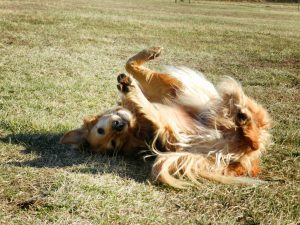
Is your dog hyperactive?! That’s right… some dogs seem to have no “pause” switch. After a walk in the park or playing until they’re wild, they come home, and the moment they step through the door, their eyes seem to say to you: “What shall we play next?”. This can be exhausting for the owner… and for the dog too!
If you have met your dog’s normal need to burn off energy (how long that takes depends on the breed and the dog’s own personality), but you still have an over-active dog that never seems to settle indoors, then perhaps your dog simply needs to learn how to relax. A super-lively dog with no “pause” switch is, generally speaking, a dog that can’t seem to stay still for more than a few minutes, or one that is always busy “greeting” or responding to every noise/sound. A super-lively dog may turn into a very stressed dog, because being unable to relax prevents it from recovering from its normal daily activities. This can leave the dog exhausted: do you know how tense and stressed we humans get when we lack proper sleep? A dog needs on average 17 hours of sleep and rest a day! So yes, your dog may be short on rest rather than short on exercise!
One of the most important things you can give your never-stopping dog is a place, in a not-too-busy part of the home, where it can calm down. This place can be a bed, a crate, a room, etc.: any comfortable, quiet spot can make a great rest area. Without surrounding stimulation, noise and movement, your dog is likely to be able to sleep and rest normally.
You can also teach your dog how to relax, just as you would teach it a new trick. First, take it easy, don’t rush, and you must reward it often. If the reward is effective, fewer and fewer rewards will be needed, and your dog will learn to relax in increasingly busy environments.
Some dogs try to please their owner by constantly jumping around them. So you may need to teach your dog that you want it to keep a calm state of mind, and that at such times you don’t need it to take any action or initiative. This may actually help your busy dog understand that calming down at the right moments makes its owner like it even more!
How to go about it?
One simple exercise you can do is to have your dog lie by your feet, or let it sleep in its bed, while you watch TV, read a book, or do any of these calm activities. Have the dog lie in the position you want; if it manages to settle down, reward it once every minute or two at first, then gradually increase the time between rewards to a few minutes. Don’t talk to or look at your dog — just toss a treat beside its paws. Otherwise, it will think you want to interact and play with it, and go straight back into the “super-active on” mode you most want to avoid…
If you have an extremely active dog that just can’t stay put, put it on a lead so it knows this is the place it needs to stay. The moment the dog settles, reward it with a treat: first sit (reward it with a treat when it’s willing to sit), then lie down (reward it with a treat when it’s willing to lie down), step by step, until finally it’s willing to rest its head on its paws, and so on.
Once your dog learns to relax more naturally at your feet, you can raise the difficulty by standing up yourself (while the dog stays still), or by having someone walk past. You can also increase the length of time you ask your dog to stay still!
This is a simple exercise you can do each day while doing something else to relax yourself. If you don’t have such rest time, then perhaps it’s time for you to start learning how to relax yourself too! An owner who knows how to relax tends to raise a dog that knows how to relax — don’t you agree? (laughs)
Here’s a recommendation: Treats for training dogs
We also have many articles about raising cats and dogs!