You often hear people say “a healthy gut means a strong immune system” – and that applies just as much to cats and dogs. As a devoted pet parent, you have almost certainly seen your pet suddenly pass soft or runny stools, vomit for no obvious reason, or get diarrhoea the moment you switch food. Watching them suffer is heartbreaking.
There are countless brands of pet probiotics on the market, so which pet probiotic is actually good? When should you start giving them, and what ingredients should you look for? This complete guide breaks down the 3 golden rules for choosing pet probiotics for Hong Kong pet parents, so you can target the real problem and protect your dog’s or cat’s sensitive tummy.
Quick 5-second answer: when should pets start taking probiotics, and how do you choose?
Key takeaway:
When your pet has long-term soft stool, constipation, bad breath or skin sensitivity, or is in the middle of switching food or a course of antibiotics, probiotics are very much needed. When choosing, look for **”a strain number (such as L. acidophilus LAP5)”, “a live bacteria count (CFU) of 2 billion-5 billion” and “encapsulation technology (so the bacteria reach the gut)”** – only these products genuinely work!
These 4 warning signs mean your cat or dog needs probiotics
An imbalanced gut flora does not just affect bowel movements – it drags down the skin and immune system too. If your pet shows any of the following signs, it is time to think about strengthening the gut:
- Frequent soft stool / runny stool / constipation: stools that do not hold their shape and stick to the fur around the anus, or difficulty passing stools that come out as small hard pellets.
- Poor digestion, easily sick or bloated: a constantly gurgling tummy, easily nauseous and vomiting yellow bile, or very smelly wind.
- Stress reaction to switching food: diarrhoea every time you change to a new food, move house, or even after a grooming session.
- Unexplained skin sensitivity and weak immunity: the gut holds 70% of a pet’s immune cells, so cats and dogs with poor digestion tend to suffer more from red, itchy skin and tear stains.
The 3 hidden codes for choosing pet probiotics
Walk around a pet shop and the packaging is covered in chemical names. In fact, just check these 3 points and you can become a probiotics expert:
1. The strain must have an “ID card” (a strain number)
Many cheap products only say “Lactobacillus acidophilus”, which is just the bacteria’s name. Quality supplements will state the strain number (for example: Lactobacillus acidophilus LAP5). A numbered strain means it has been clinically proven to survive stomach acid and successfully colonise the gut.
2. More live bacteria (CFU) is not always better
When buying probiotics, check the live bacteria count (usually shown as CFU). For everyday maintenance, 2 billion to 5 billion live bacteria per dose is plenty. Blindly chasing counts in the tens of billions is pointless – without good protective technology, they will all be killed off by stomach acid anyway.
3. Always pair with prebiotics
Prebiotics (such as fructo-oligosaccharides, FOS, and inulin) are food for the probiotics. With prebiotics to support them, probiotics survive longer and multiply faster once they reach the gut. This “probiotics + prebiotics” combination is professionally known as synbiotics.
Handy reference table: which strain suits which symptom?
| Your pet’s condition | Recommended strains | Main benefits |
| Everyday maintenance / smooth food switching | Lactobacillus acidophilus (L. acidophilus), Enterococcus faecium (E. faecium) | Maintains basic gut flora balance and aids digestion |
| Acute diarrhoea / after antibiotics | Bacillus coagulans (Bacillus coagulans), Saccharomyces boulardii (S. boulardii) | Acid- and heat-resistant, quickly suppresses bad bacteria, very effective at stopping diarrhoea |
| Long-term constipation / sluggish gut | Bifidobacteria (the Bifidobacterium family, such as Bifidobacterium bifidum) | Stimulates gut movement and eases constipation |
| Skin sensitivity / eczema-prone skin | Lactobacillus paracasei (L. paracasei), Lactobacillus rhamnosus (L. rhamnosus) | Regulates the immune system and improves allergy-prone constitutions |
Feeding tips: how do you get the most out of probiotics?
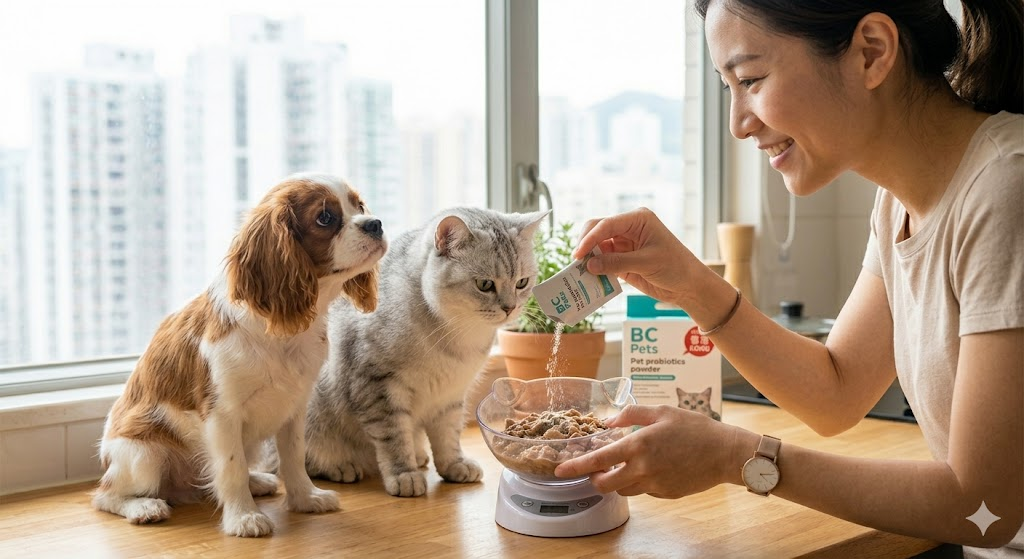
- Avoid hot water and hot food: probiotics hate heat. Mix them into cool boiled water, room-temperature wet food or dry food. Above 40°C the live bacteria start to die off.
- Space them apart from antibiotics: if your pet has been prescribed antibiotics by the vet, those antibiotics kill good and bad bacteria alike. Give probiotics at least 2 hours after the antibiotic dose.
- They need time to colonise: probiotics are not a laxative. It usually takes 1-2 weeks of continuous use to rebalance the gut, so be patient and feed them every day.
BC Pets hand-picks top-tier digestive care for your pet
Do not let your pet keep suffering from vomiting and diarrhoea. Get gut health under control early, so every meal is absorbed properly and the coat naturally turns glossy.
BC Pets has sourced a wide range of professional pet probiotics that are bestsellers in Europe, the US, Taiwan and Japan for Hong Kong owners. All of them use patented strains and acid-resistant technology, so they are safe for fussy cats and sensitive-stomached dogs alike.
💡 Frequently Asked Questions (FAQ)
Q1: Can I share human probiotics with my cat or dog?
A: Please do not. First, the gut flora of humans and of cats and dogs are completely different, so a strain that works for people is not necessarily suitable for pets. Second, human probiotics often contain xylitol, glucose, fragrances or flavourings, which are highly toxic to cats and dogs or place a heavy metabolic burden on them. Always choose probiotics made specifically for pets.
Q2: If my cat or dog takes probiotics every day, will they become dependent on them?
A: No. Probiotics are a food-grade nutritional supplement. Pets naturally lose good gut bacteria through stress, diet and ageing. Topping them up regularly simply helps maintain the population of good bacteria – it does not make the gut “lazy” or cause it to lose its own function.