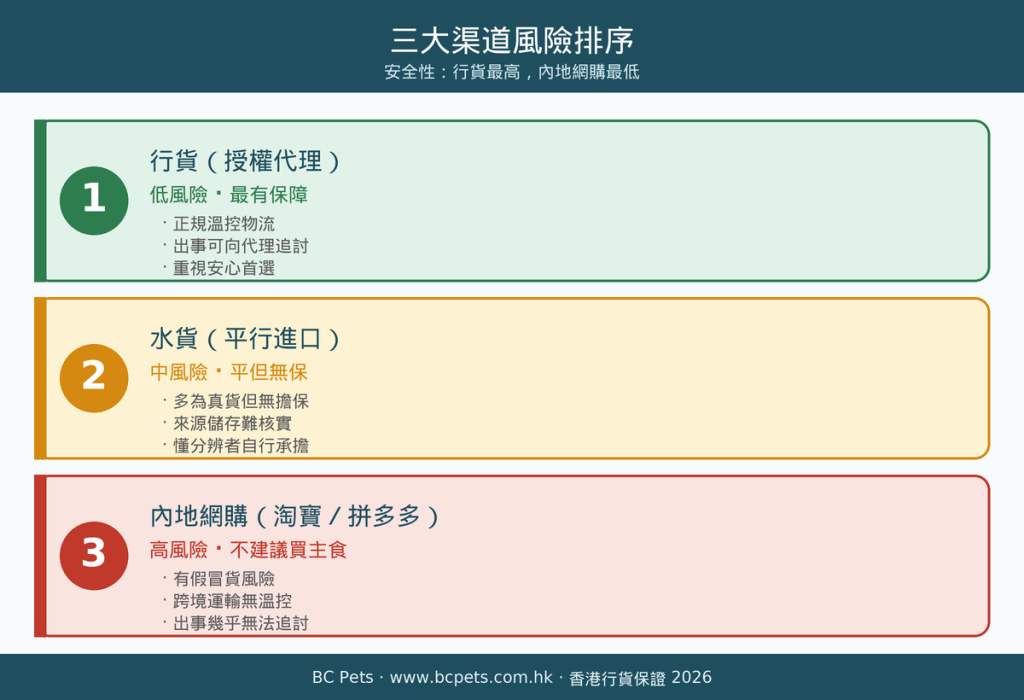
Quick answer:In Hong Kong there are three main sources of cat and dog food — genuine local goods (imported by authorised agents, with a local guarantee and after-sales support), parallel imports (parallel imports, cheaper but with no local warranty or quality guarantee), and mainland online shopping (Taobao, Pinduoduo — the lowest price but the highest risk). Weighing safety and protection overall, genuine local goods are the safest, parallel imports come next, and mainland online shopping carries the greatest risk. The main worries with mainland online shopping are: counterfeit goods, cross-border shipping without temperature control letting food spoil in Hong Kong’s heat and humidity, regional formula and labelling differences, and the near impossibility of seeking redress if something goes wrong. Selection principle: make genuine local goods your first choice; if you are considering parallel imports or online shopping, always check the batch and expiry date, watch out for suspiciously low prices, and accept the risk of having no local after-sales support.
Key summary (TL;DR):
- Pet food in Hong Kong is “unregulated”:Local law generally does not regulate the production, import or distribution of pet food, so safety mainly depends on how trustworthy the source is.
- Genuine local goods = protected:Imported by authorised agents, with an authenticity guarantee and Chinese labelling; if something goes wrong you can seek redress from the agent or the store.
- Parallel imports = cheap but unprotected:Parallel importing is legal in most cases in Hong Kong, but there is no local warranty, and the source and storage conditions are hard to verify.
- Mainland online shopping = highest risk:Taobao and Pinduoduo have been placed on a US counterfeit list; with no temperature control during cross-border shipping, cat and dog food spoils easily.
- Hong Kong’s climate is key:Temperatures above 27°C speed up fat oxidation and spoilage, high humidity encourages mould, and shipping conditions directly affect quality.
- The money you save may come at a health cost:What you save may not be worth the vet bills and the cost to your pet’s health.
Why the “source” of cat and dog food matters especially in Hong Kong
Many Hong Kong pet owners assume cat and dog food is strictly vetted by the government, but that is not the case. According to research material from the Legislative Council of Hong Kong, the production, import and distribution of pet food in Hong Kong is generally not regulated by local law, with no mandatory import inspection or safety standards like those in the EU, the US or Singapore. The media has also reported on the issue under headlines such as “Pet food is unregulated, and owners struggle to seek redress when things go wrong“.
In other words, when regulation is absent, who you buy from and where the goods come from become the last line of defence for quality.For the very same cat food or dog food, buying genuine local goods, parallel imports, or ordering online from Taobao/Pinduoduo can differ enormously in price and risk. We break each down below.
Three terms to get straight first: genuine local goods, parallel imports, mainland online shopping
- Genuine local goods:Goods formally imported by the brand’s authorised Hong Kong agent, with a local guarantee and Chinese labelling; if there is a problem you can seek redress through the agent or retailer.
- Parallel imports:Products brought into Hong Kong through channels other than the authorised agent; they are genuine goods. Parallel importing itself is legal in most cases in Hong Kong, but they do not enjoy the manufacturer’s or agent’s local warranty and support.
- Mainland online shopping:Ordering through mainland e-commerce platforms such as Taobao and Pinduoduo, with delivery to Hong Kong via cross-border logistics. The price is often the lowest, but the source, authenticity and shipping conditions are the hardest to pin down.
Tip:“Parallel imports” does not mean “fakes”. Parallel imports can be genuine; the issue lies in protection, shipping and storage; whereas mainland online shopping, besides the same storage problems, carries the added risk of buying counterfeit goods. The two should be understood separately.
Genuine local goods: the most protection, but usually a higher price
The greatest value of genuine local cat and dog food is that “someone is accountable when something goes wrong“. Authorised agents are responsible for the source, shipping and storage of the goods; the products usually carry Chinese labelling and a clear batch number and expiry date, and if you encounter a quality problem or product recall, you can seek redress or an exchange from the agent or store. For cat and dog owners who value peace of mind, genuine local goods are the lowest-risk choice.
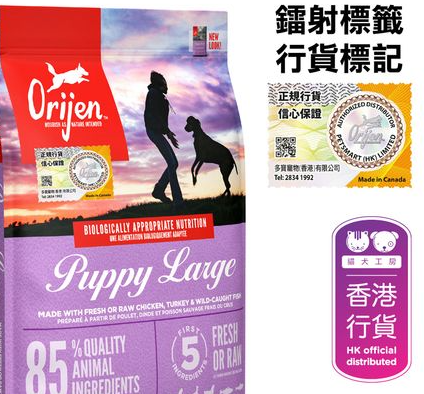
The drawback is that the price is usually higher than parallel imports and online shopping; this reflects the costs of proper importing, warehousing, quality control and after-sales service.
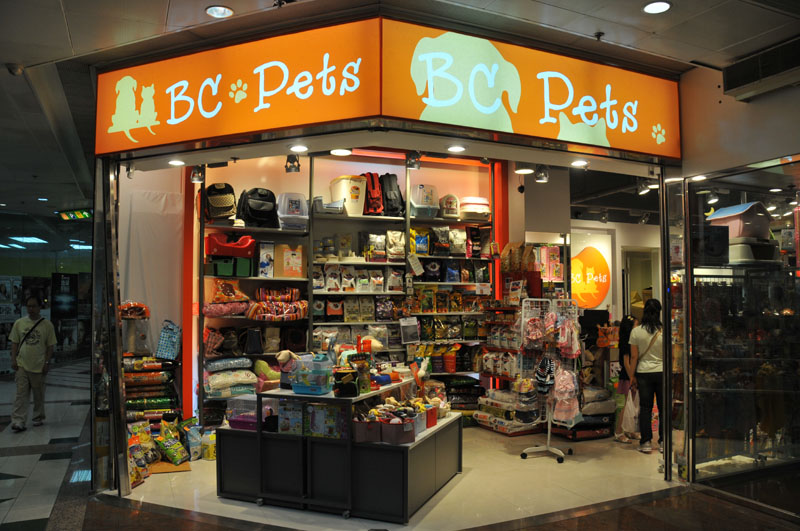
Key point:To judge whether something is genuine local goods, check whether the packaging has a Hong Kong agent’s Chinese label, local customer-service details or agent information. All BC Pets cat and dog food comes with a Hong Kong genuine local goods guarantee.
Parallel imports: noticeably cheaper, but with no local protection
Parallel-import cat and dog food is attractive on price — with the agent layer removed, pricing is sometimes noticeably lower. It has real appeal for budget-conscious owners, and many parallel imports are indeed genuine. But be clear about the trade-offs:
- No local warranty or support:If a problem arises it is hard to find the agent, and there is nowhere to turn for help.
- Source and storage hard to verify:You cannot confirm whether it was exposed to heat or moisture during shipping and warehousing.
- Batch and recall tracking is difficult:If the brand issues a product recall, parallel imports are often outside the notification scope.
- Regional formula differences:The same brand may have different formulas and labelling languages in different markets.
Tip:If you choose parallel imports, be sure to check that the expiry date is far enough off and that the packaging is not damaged or leaking air, and confirm the source with the seller. Be especially wary when the price is “unbelievably cheap”.
Mainland online shopping (Taobao / Pinduoduo): the cheapest, but the highest risk
Buying cat and dog food through Taobao and Pinduoduo is often the most tempting on price, but the hidden risks are also the most concentrated, mainly in four areas:
- Counterfeit risk:The Office of the United States Trade Representative (USTR)’s 2025 “Notorious Markets List” includes platforms such as Taobao and Pinduoduo, reflecting international concern over counterfeit and infringing goods on them. There have also been cases of pet food in counterfeit packaging.
- No temperature control in cross-border shipping:Food may travel long distances, exposed to hot warehouses and blazing sun (see the next section).
- Regional formula and labelling differences:Mainland versions may differ from the Hong Kong, US and EU versions in formula, labelling and expiry-date format, making them hard to check.
- Almost no redress when things go wrong:Once something goes wrong with a cross-border purchase, returns, claims and providing proof are all extremely difficult.
Key point:The money saved on mainland online shopping, once it results in health problems from fake or spoiled food, often costs far more in vet bills and pet suffering than was ever saved. Cheap is not necessarily cheap.
Hong Kong’s climate: why “shipping and storage conditions” make or break quality
Cat and dog food (especially dry food) contains fats and is very sensitive to temperature and humidity. According to the Tufts University veterinary school’s Petfoodology and similar sources, temperatures above roughly 27°C (80°F) accelerate fat oxidation, turning the food “rancid” (rancidity), and destroy vitamins E and C; excessive humidity (above about 60%) makes food prone to mould and bacterial growth.
Hong Kong summers routinely exceed 30°C with prolonged high humidity — exactly the high-risk environment for food spoilage. Genuine local goods travel through temperature-controlled proper logistics and warehousing; parallel imports and mainland online purchases often lack this layer of protection — the food may have been “baked” inside a container, warehouse or in transit, looking normal on the outside while its nutrients have already been lost or gone rancid. Beyond price, this is the most easily overlooked yet most crucial difference.
| Storage condition | Effect |
|---|---|
| Sustained above 27°C | Accelerates fat oxidation and rancidity; loss of vitamins |
| Humidity above 60% | Prone to mould and bacterial growth; can grow mould within 1–2 weeks of opening |
| Large temperature swings, direct sunlight | Repeated oxidation, accelerating spoilage |
| Cool and dry (below 27°C) | Unopened dry food generally keeps for 12–18 months; once opened, use within 6 weeks |
Comparison table of the three main purchase channels
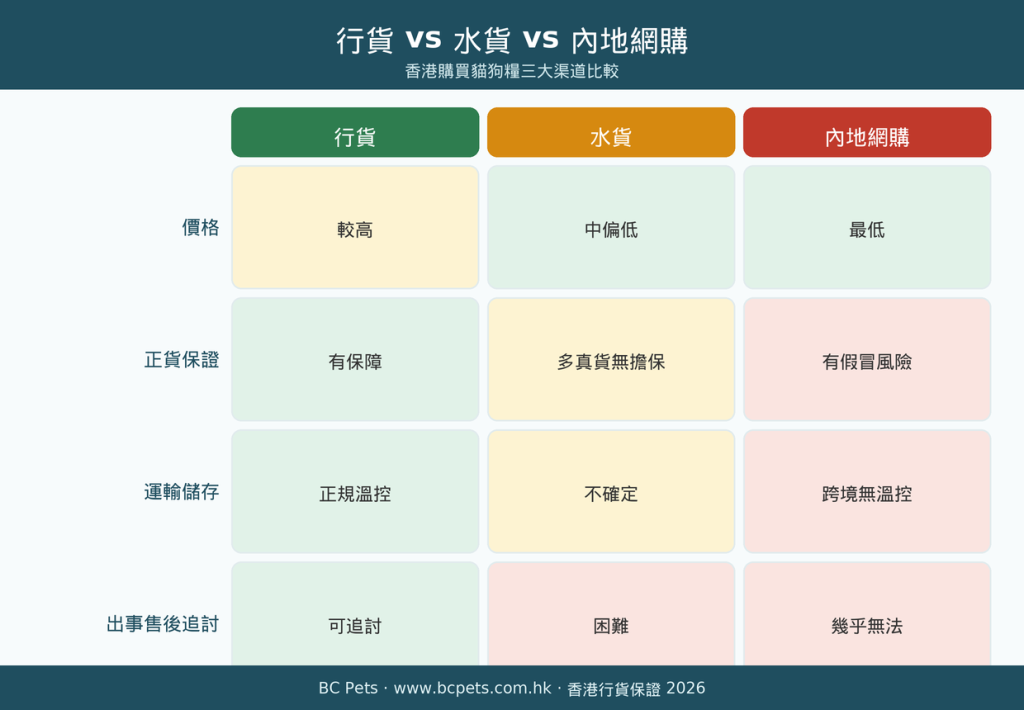
The table below compares Hong Kong’s three main purchase channels. Prices are general observations for reference only and will fluctuate with brand and time.
| Item | Genuine local goods (authorised agent) | Parallel imports | Mainland online shopping (Taobao / Pinduoduo) |
|---|---|---|---|
| Price | Higher | Moderate to low | Lowest |
| Authenticity guarantee | Yes, guaranteed by the agent | Mostly genuine, but no guarantee | Lowest; risk of counterfeits |
| Shipping and storage | Proper temperature-controlled logistics | Uncertain | Long cross-border transit, usually without temperature control |
| Chinese labelling / local agent | Yes | Not necessarily | Mostly mainland-version labelling |
| Regional formula consistency | Matches the local market | Depends on the source | Mostly mainland formula |
| After-sales / redress when things go wrong | Can seek redress from the agent or store | Difficult | Almost impossible to seek redress |
| Best suited for | Those who value peace of mind and protection | Those who can tell the difference and are willing to bear the risk | Extremely price-driven buyers who accept the risk themselves |
Our recommendation as a brand (pick one of three):If what you value most is your pet’s health and buying with peace of mind, we suggest going straight for genuine local goods, saving you the trouble of telling real from fake and worrying about spoilage, with a channel for redress if things go wrong; if your budget is limited and you know how to tell the difference, you might consider parallel imports from a reliable seller, but be sure to check the expiry date and packaging; as for Taobao / Pinduoduo online shopping, we do not recommend it for staple-diet cat and dog food — the money saved hardly offsets the health risks from fakes and spoilage.
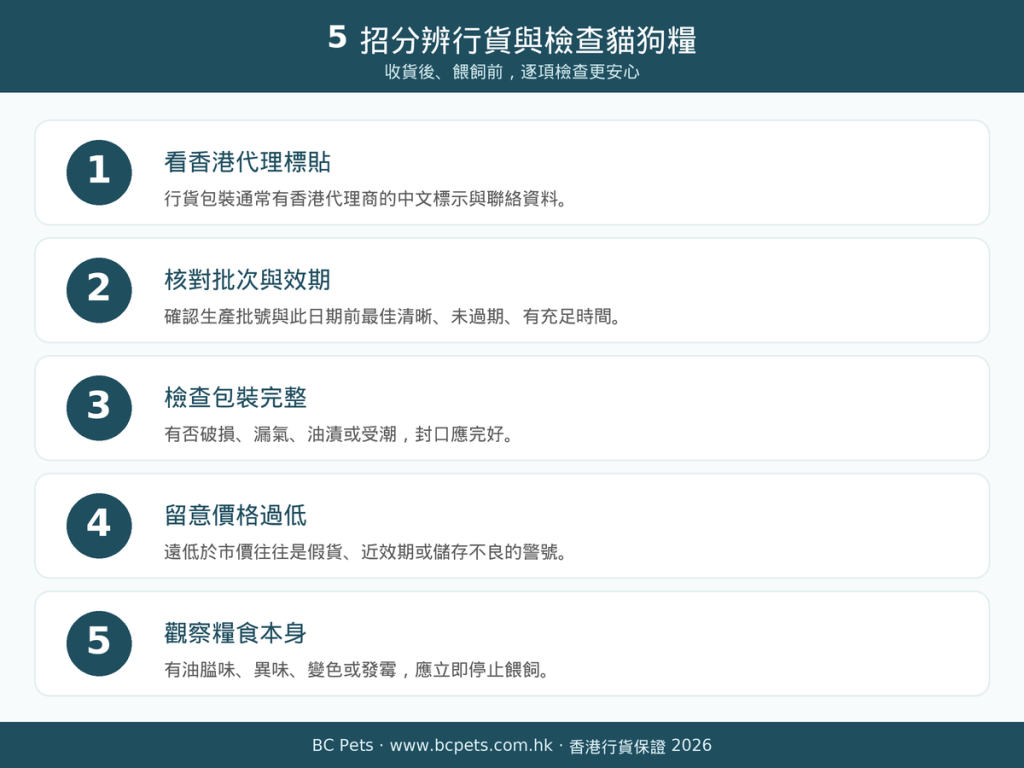
5 tips for identifying genuine local goods and checking cat and dog food
- Check the Hong Kong agent’s label:Genuine local goods packaging usually carries the Hong Kong agent’s Chinese labelling and contact details.
- Check the batch and expiry date:Confirm that the production batch number and “best before” date are clear, not expired, and with plenty of time left before the expiry date.
- Check the packaging is intact:Look for damage, air leaks, oil stains or moisture; any vacuum seal or closure should be intact.
- Watch out for prices that are too low:A price far below the market rate is often a warning sign of fakes, near-expiry stock or poor storage.
- Examine the food itself:After opening, if there is a rancid smell, an off odour, discolouration or mould, stop feeding it immediately.
Tip:Whether genuine local goods or parallel imports, always smell and inspect before feeding once you receive them. Cats’ and dogs’ digestive systems are more sensitive than ours, and spoiled food can cause vomiting, diarrhoea or even more serious problems.
Frequently asked questions (FAQ)
Generally, no. Parallel importing is legal in most cases in Hong Kong, and there is no law specifically regulating pet food imports. The issue is not legality but that parallel imports lack a local agent’s quality guarantee and after-sales protection; the source and shipping and storage conditions are also harder to verify, and the risk falls on the buyer.
The risk is quite high, and it is not recommended for staple-diet cat and dog food. Taobao and Pinduoduo have been placed on the Office of the US Trade Representative’s “Notorious Markets List”, with counterfeit-goods issues drawing international concern; on top of that, cross-border shipping usually has no temperature control, food spoils easily in Hong Kong’s hot and humid climate, and there is almost no redress if something goes wrong. If you really must buy, limit it to lower-risk, non-staple items that can be used up right away.
For owners who value peace of mind, yes. The price difference for genuine local goods reflects the costs of proper importing, temperature-controlled logistics, quality control and local after-sales service. What you buy is not just food but the assurance that “someone is accountable when something goes wrong” — Chinese labelling, a verifiable expiry date, recall notifications, and the ability to seek redress from the agent or store over quality problems. For your pet’s health, that certainty is often well worth it.
The most direct way is to check whether the packaging has the Hong Kong agent’s Chinese label and local contact details — genuine local goods usually do, parallel imports may not. Next, check that the batch and expiry date are clear and the packaging is intact and undamaged. If the price is far below the usual market rate, or the seller cannot explain the source, be on your guard — it may be a parallel import or even goods of unknown origin.
Because cat and dog food contains fats and is especially sensitive to heat and moisture. Temperatures sustained above roughly 27°C accelerate fat oxidation, turn food rancid and destroy vitamins; excessive humidity encourages mould. Hong Kong summers are hot and humid, and if food lacks temperature control during shipping or warehousing, it may look normal while its nutrients have actually been lost or spoiled. This is exactly the key advantage of genuine local goods’ proper logistics over parallel imports and online shopping.
Not necessarily identical. The same brand may differ across markets (mainland China, Hong Kong, the US, Europe) in formula, ingredient sourcing, labelling language and expiry-date format. What you buy through mainland online shopping is mostly the mainland version, which may not match the Hong Kong or imported specification you expect, and checking the ingredients and expiry date is harder too, so take extra care before feeding.
You have to count the “total cost”, not just the sticker price. The money saved, once it leads to vomiting, diarrhoea or even chronic health problems from fake, near-expiry or spoiled food, often costs far more in vet bills and pet suffering than was saved. For everyday staple food, a stable, trustworthy and protected source is usually the better deal in the long run.
Limitations and disclaimer:This article is compiled from public sources including Legislative Council of Hong Kong research material and the Tufts University veterinary school, together with BC Pets’ store experience; information is current as of June 2026, and regulations and market conditions may change in future. The prices and comparisons in this article are for general reference only, and individual brands and sellers vary; if you have questions about your pet’s diet or health, please consult a registered veterinarian. If you find any errors in this article, you are welcome to contact us to correct them via the www.bcpets.com.hk “Contact Us” section.
Conclusion: three principles for choosing a cat and dog food channel
Faced with genuine local goods, parallel imports and mainland online shopping, remember three principles. First, the trustworthiness of the source determines quality protection, which matters especially given the reality that pet food is unregulated in Hong Kong; second, shipping and storage conditions must not be overlooked, as Hong Kong’s heat and humidity make this even more crucial than price; third, count the total cost rather than just the sticker price, as the money saved may not be worth the health risk. On balance, genuine local goods offer the most comprehensive protection and are the safest choice for most cat and dog owners.
Shop protected genuine local cat and dog food now
Want to buy with confidence and feed with peace of mind? BC Pets Pet Supplies Centre sells only cat and dog food that is genuine Hong Kong local goods, imported by authorised agents, stored in proper temperature-controlled warehousing with clearly labelled expiry dates, and backed by a genuine local goods guarantee and professional in-store advice.Browse the BC Pets genuine local cat and dog food range now and pick a trustworthy meal for your furry companion.
Disclosure of interest:BC Pets Pet Supplies Centre (www.bcpets.com.hk) is a Hong Kong genuine local goods pet food and supplies retailer; all cat and dog food we sell is imported by authorised agents and comes with a genuine local goods guarantee. The purpose of this article is not merely to sell, but to use Hong Kong’s current regulations, public information from government and academic bodies, and our store’s real experience to help you objectively compare the pros and cons of the three purchase channels, then make a wise choice for yourself.